
Hybspec
2026-03-1012 minLive Data i DiagnostykaSeries: Diagnostyka / Live Data

Live Data in Car Diagnostics: What Engine Parameters Tell You Before You Clear the Code?

You type the fault code into the internet, clear the warning light, and hope the issue goes away. In practice, that's the shortest path to a recurring fault and a parts-replacement lottery. Live data isn't an add-on to diagnostics. It's the core, because only in the data can you see whether the control unit is reacting to a real mechanical or electrical problem, or just a side effect.
Car engine bay with a laptop displaying live sensor data while a mechanic reviews parameters.

In Short: Live Data Shows Real-Time System Behavior, Not Just a Fault Number

If the car has Check Engine, EPC, lack of power, or intermittent jerking, the DTC code alone usually doesn't tell you what to replace. Live data shows how the system works under specific load, temperature, and RPM.

That's why professional diagnostics look at fuel trims, boost pressure, throttle position, temperatures, injection quantities, and the control unit's response, not just the fault description from an app.

If you want to see how this same process works in practice on a specific brand, also read: BMW drivetrain scenarios and Audi EPC and S tronic logs.

Zapamiętaj

Komunikat vs dane

Komunikat to dopiero początek. Dane dopiero zaczynają rozmowę.

You type the fault code into the internet, clear the warning light, and hope the issue goes away. In practice, that's the shortest path to a recurring fault and a parts-replacement lottery.

Symptoms Where Live Data Has More Value Than Just Clearing the Fault

The biggest advantage of live data is seen where the symptom is variable. The car drives well sometimes, goes into limp mode other times, sometimes stalls only when cold, or jerks only under a specific load.

In such situations, reading stored DTCs is necessary, but it's only the first step. The key is capturing the moment when parameters start to deviate from normal: fuel trims drift, boost pressure lags, fuel quantity drops, or the control unit limits torque.

Typical cases where dynamic logs save the most money include: EPC and lack of power in VAG, drivetrain message in BMW, AdBlue problems and limp mode in Mercedes, and the check emission system message in Honda.

  • symptom appears only when cold or only when warm
  • fault returns after clearing, but without a permanent code
  • car loses power only under load or on the highway
  • engine runs rough, though fault codes are inconsistent or very generic

What Exactly Is Live Data and How Is It Different from a DTC Code?

A fault code is a label. The control unit stores it when a logical condition has been violated: the signal went out of range, a test was not passed, or the system's reaction was illogical. Live data, on the other hand, is the raw and calculated parameters on which the control unit based that decision.

In practice, this means code P0171 doesn't yet tell you whether the cause is an intake leak, a MAF sensor, too low fuel pressure, or a faulty temperature reading. Live data narrows it down because it shows short-term and long-term fuel trims, engine load, air flow, MAP, and temperatures.

That's why a good computer diagnostics for a combustion engine car starts with collecting data, not with clearing faults.

Did you know...Diagnostics

Nowsze samochody (od ~2019) używają protokołu DoIP (Diagnostics over IP) zamiast klasycznego CAN — diagnostyka odbywa się przez Ethernet z prędkością do 100 Mbit/s.

Read more
Did you know...Batteries

Dla baterii NMC złota zasada to "ładuj do 80%, rozładowuj do 20%". Regularne ładowanie do 100% przyspiesza degradację chemiczną katody o nawet 30% w porównaniu do limitu 80%.

Read more

OBD2 Freeze Frame: What It Is and Why You Must See It Before Clearing the Fault

Freeze frame is a snapshot of the conditions under which the control unit stored the fault. It includes, among other things, RPM, coolant temperature, load, vehicle speed, throttle position, and pressure values at the moment the problem was detected.

This is critical information because it lets you distinguish a fault that occurs when cold from one that appears only after warming up, under heavy load, or at a constant speed. Without freeze frame, it's very easy to go down the wrong path and replace a part that is merely honestly reporting a symptom.

If a mechanic clears faults before saving the frame, you lose the most valuable diagnostic context. That's why, before any decision to reset, it's worth making a data dump and only then moving on to a test drive.

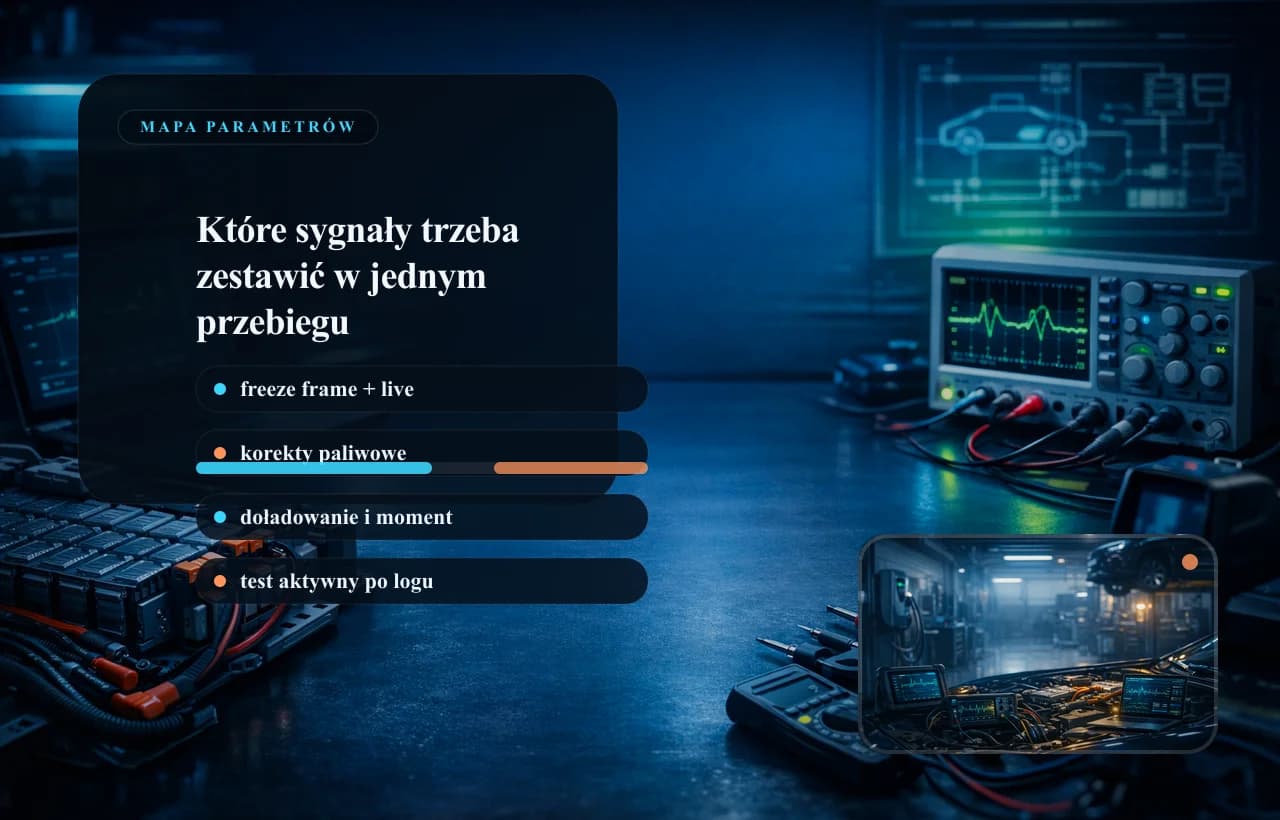
Diagnostic process panel: freeze frame, live data, road log, and active test.
Live Data

Fault Code is the Beginning, Not the Diagnosis

First, read the fault storage conditions, then observe live parameters, and only then decide what to measure next.

VAG Measuring Blocks and Dynamic Logs: How to Do Them So They Actually Mean Something?

Users often search for phrases like "VAG measuring blocks" and "VAG dynamic logs," but a screenshot of a few groups alone doesn't provide an answer. You need to know which channels to record simultaneously and in what driving scenario to replicate the symptom.

For lack of power in TSI or TDI, the following are often important simultaneously: requested and actual boost, air flow, fuel pressure, ignition timing, wastegate or N75 valve position. For DSG, temperatures, pressures, clutch slip, and learned values come into play.

If you want to see ready-made scenarios for VAG, read: diagnostic cases of Skoda EPC and Audi EPC and S tronic scenarios.

Typowa pułapka

Koszt błędnej interpretacji

Najdroższa interpretacja zwykle pojawia się za wcześnie.

Users often search for phrases like "VAG measuring blocks" and "VAG dynamic logs," but a screenshot of a few groups alone doesn't provide an answer. You need to know which channels to record simultaneously and in what driving scenario to replicate the symptom.

How to Read Live Data Results and Not Mistake the Effect for the Cause?

The most common mistake is when a user sees a parameter out of range and automatically assumes that component is faulty. But the control unit operates in a network of dependencies. A MAF sensor fault can be the result of an intake leak, a lambda sensor fault the result of an exhaust leak, and a fuel pressure problem the result of a voltage drop.

Therefore, every reading must be interpreted in pairs or groups. A high fuel trim alone says little without temperatures, MAP, and MAF. A low boost value alone is not enough without analyzing wastegate control, ignition timing, and load.

Professional interpretation always looks like this: symptom, hypotheses, confirmation in data, active test or physical measurement, and only then a repair decision.

  • a single parameter is rarely a diagnosis
  • requested and actual values must be compared at the same time
  • you need to know whether the control unit is deliberately limiting the system or simply cannot keep up with the command

When Are Logs Alone Enough, and When Do You Need an Active Test, Pressure Measurement, or Oscilloscope?

If the log shows a consistent deviation and it can be easily confirmed with a simple test, that's often enough to make a decision. For example, an intake leak is often visible in fuel trims and MAF behavior after just a few minutes of analysis.

However, there are situations where live data only shows the consequence. A crankshaft sensor fault, intermittent misfire, disturbed pressure sensor signal, or wiring fault under load require going down to the level of electrical signals or active tests.

In such cases, logs are essential but don't end the process. They point to where to measure next.

Decision: When Not to Clear Faults, But to Immediately Secure Data and Schedule Diagnostics

If the symptom is repeatable, the car loses power, or goes into limp mode, the best decision is to secure the freeze frame, save the live data, and describe the conditions under which the problem occurred. This shortens later diagnosis and reduces the risk of misdiagnosed parts.

If you want to move from theory to a specific brand, also see: BMW drivetrain malfunction and live data, Mercedes AdBlue and limp mode in data, and Honda check emission system and P0299.

When you need a specific measurement plan for your car, one thing makes sense: engineering computer diagnostics with logs and active tests.

FAQ: Live Data, Logs, and Interpretation of Engine Parameters

Is reading the fault code alone enough to make a diagnosis?+

No. The fault code shows the problem area, but doesn't automatically point to the damaged part. Only live data, freeze frame, and active tests show whether the control unit sees the cause or just the consequence of the fault.

Which is more important: freeze frame or live data?+

Both are needed, but they answer different questions. Freeze frame shows the conditions when the fault was stored, while live data lets you check if the problem is still present and how the system behaves under load.

Can you do good dynamic logs with a cheap OBD scanner?+

Sometimes you can collect some data, but usually the sampling rate, number of channels, and connection stability are too poor. For more difficult faults, read speed, full control unit coverage, and the ability to correlate data with active tests matter.

Why does the car drive better for a while after clearing faults?+

Because the control unit loses its stored adaptations and fault history, so it temporarily runs in a base mode. If the root cause hasn't been fixed, the problem returns after a few drive cycles or once specific test conditions are met.

When are logs alone not enough?+

When you need to confirm the physical state of a signal or actuator. For example, live data may show a sensor fault, but only an oscilloscope, pressure measurement, or active test will confirm whether the sensor itself, the wiring, or the control unit is at fault.

Related services

If you want to verify this, check the service

Consult result

Diagnostyka BMW: drivetrain, live data, adaptacje

Drivetrain Malfunction, adaptacje po naprawie, Live Data i diagnostyka hybryd eDrive. Mobilnie · Łódź i woj. łódzkie · ogólnopolsko po ustaleniu.