Hybspec
2026-03-1010 minLive Data i DiagnostykaSeries: Skoda / Live Data

Live Data Skoda: EPC, 1.5 TSI Kangaroo and DSG Without Guessing

Skodas very often end up in workshops with seemingly simple symptoms: EPC, power loss, DSG jerking or the characteristic 'kangaroo' in the 1.5 TSI. The problem is that these symptoms can originate from both the engine and the way the ECU manages torque, adaptations and the transmission.

Skoda in a workshop with a diagnostic screen displaying EPC and DSG transmission live data.

In Brief: In a Skoda, You Must Separate the Engine Symptom from the Torque Control and Transmission Symptom

With EPC and jerking in a Skoda, it's very easy to fall into the trap of replacing parts based on a single fault code. Meanwhile, the symptom can result from engine operating logic, adaptations, or the way the transmission receives torque from the powertrain.

First, look at engine data, only then evaluate the transmission. Otherwise, you can wrongly blame the DSG for a problem that started with ignition, turbocharging or throttle control.

We discuss the method of working with freeze frame and parameters in more detail here: practical guide to live data and freeze frame.

Zapamiętaj

Komunikat vs dane

Komunikat to dopiero początek. Dane dopiero zaczynają rozmowę.

Skodas very often end up in workshops with seemingly simple symptoms: EPC, power loss, DSG jerking or the characteristic 'kangaroo' in the 1.5 TSI. The problem is that these symptoms can originate from both the engine and the way the ECU manages torque, adaptations and the transmission.

Skoda EPC: What the Warning Light Means and Why the Car Loses Power

The phrase 'Skoda EPC' and 'Skoda EPC power loss' comes up regularly because the driver only gets a general signal about a powertrain control problem. Key parameters in the data are: Accelerator Position vs Throttle Valve Angle (a discrepancy >5% signals a potentiometer or by-wire issue), Boost Pressure Actual vs Specified (in the 1.5 TSI target ~1.35 bar at WOT — a drop below 0.9 bar = underboost P0299), LTFT Bank 1 (norm ±5%, concerning >±12%, alarming >±15%) and Torque Limitation Active (ECU protective flag).

Only then is it clear whether the ECU doesn't trust the signal or sees conditions threatening safe engine operation. If Ignition Timing Advance drops to 0° or negative values under load, it's typical knock protection — not an ignition fault.

Skoda Octavia Power Loss: Which Measuring Blocks and Dynamic Logs Are Worth Recording First?

The query 'Skoda Octavia power loss' alone is too broad, but that's exactly why live data has the most value here. You need to see whether the problem concerns air, fuel, ignition, torque or perhaps temperatures.

In practice, a good log includes simultaneously: Boost Pressure Actual vs Specified (difference >0.15 bar = anomaly), Engine Load (norm 20–30% idle, >85% at WOT), Throttle Valve Angle, LTFT and STFT (STFT oscillates ±3% = norm; LTFT >+15% = chronic lean condition, most likely an intake leak), Ignition Timing Advance and Transmission Input Torque, if the symptom appears during gear changes.

Did you know...Makes & Platforms

Chińskie EV (BYD, MG) mają "Security Gateway" blokujący dostęp diagnostyczny standardowymi narzędziami OBD2 — potrzebne są dedykowane biblioteki i autoryzacje.

Read more
Did you know...Batteries

Baterie LFP (np. BYD Blade Battery) powinny być ładowane do 100% co najmniej raz w tygodniu — to pozwala BMS prawidłowo zbalansować napięcia w celach.

Read more

Skoda Octavia 1.5 TSI Kangaroo: Is the Software, Adaptation, Mixture or Torque Delivery to Blame?

The phrase 'Skoda Octavia 1.5 TSI kangaroo' is a very specific user problem: jerking during gentle acceleration at 1200–1800 RPM and 20–40% load. This is not a single fault with one fault code, but a phenomenon visible in the data as Torque Actual oscillation of ±15–25 Nm with a stable pedal position.

Key parameters in logs are: Accelerator Position (should be stable ±1%), Throttle Valve Angle (delay >200 ms = by-wire problem), Boost Pressure Actual (fluctuation >0.1 bar in stable conditions = wastegate or recirculation valve), Ignition Timing (retard >5° from base = active knock protection). Without recording this exact driving scenario, you cannot honestly determine whether the software, adaptations or a physical component problem is to blame.

Typowa pułapka

Koszt błędnej interpretacji

Najdroższa interpretacja zwykle pojawia się za wcześnie.

The phrase 'Skoda Octavia 1.5 TSI kangaroo' is a very specific user problem: jerking during gentle acceleration at 1200–1800 RPM and 20–40% load. This is not a single fault with one fault code, but a phenomenon visible in the data as Torque Actual oscillation of ±15–25 Nm with a stable pedal position.

Skoda DSG Jerks: When the Data Shows the Transmission, and When the Problem Starts on the Engine Side

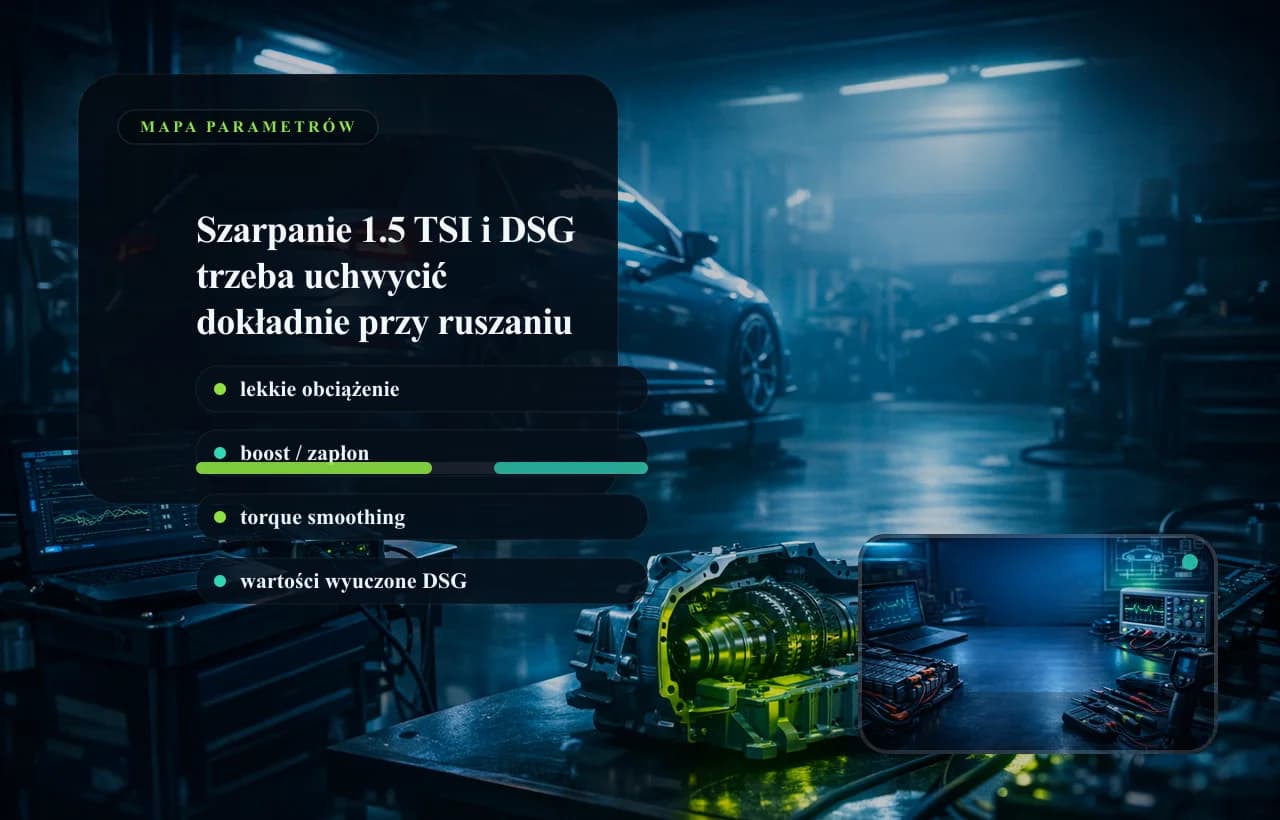
Skoda live data panel: EPC, 1.5 TSI, road log and DSG learned values.
Skoda Live Data

Kangaroo is a Symptom, Not a Diagnosis

In the data you need to check torque, ignition, throttle and transmission behavior. Without this, jerking remains just a driver's feeling.

The query 'Skoda DSG jerks' very often leads drivers straight to the mechatronics. In the DQ200 (dry dual-clutch), key parameters are: Clutch 1/2 Slip (norm <3%, alarming >5%), Gearbox Oil Temperature (norm 80–110°C, at >130°C the ECU limits torque), Clutch Adaptation Values (if they exceed the factory range — clutches need replacement, cost 3,500–5,500 PLN).

But before spending that money, you must correlate Engine Torque Actual with Transmission Input Torque. If the input torque from the engine oscillates ±20 Nm, the transmission is only revealing the symptom, not its source. Without this correlation, any transmission diagnosis is incomplete.

We discuss very similar pitfalls in the article: Audi EPC analysis on logs.

How to Distinguish a Bad Adaptation from a Real Fault in a Skoda

Adaptation makes sense when the system is mechanically and electrically sound, and the problem concerns learned values. If the data shows that a parameter does not reach the expected value, adaptation usually won't fix anything.

Therefore, you must first answer whether the system can correctly execute the command. Only then does resetting and relearning make sense.

Decision: When a Road Log Is Enough, and When a Skoda Requires Full Brand Diagnostics

If the symptom is mild, repeatable and you have the fault context preserved, you can start with a well-planned road log. However, if the EPC returns, the car loses power, and the transmission jerks more and more noticeably, it's a waste of time to try random adaptations.

In that case, the proper path is Skoda diagnostics on dynamic logs, DSG and engine data.

FAQ: Live Data Skoda, EPC, 1.5 TSI and DSG

Does EPC in a Skoda always mean a fault with the engine itself?+

No. EPC relates to electronic powertrain control. It can indicate a problem with ignition, throttle, accelerator pedal, turbocharging, and sometimes also a torque inconsistency seen by the transmission or auxiliary systems.

What do users mean by '1.5 TSI kangaroo'?+

Most often it refers to jerking or torque fluctuation during gentle acceleration, usually at low RPM and partial load. To determine the cause, you need to see logs of torque, ignition, throttle and boost.

Does a DSG adaptation solve every jerking problem?+

No. Adaptation only helps when the problem concerns learned values or operating conditions after service. If the data shows illogical pressures, slip or an engine-side issue, adaptation alone won't fix it.

Is it worth clearing the EPC before diagnostics to see if it returns?+

It's not worth doing before saving the data. Freeze frame and fault history often show under what conditions the ECU limited the powertrain. Clearing it loses that information.

What information helps most with EPC or kangaroo symptoms?+

The moment the symptom occurs, engine temperature, gear, driving mode, transmission type, and whether the problem appears with gentle or hard throttle. This helps better set up the logging scenario.

Related services

If you want to verify this, check the service

Consult result