Hybspec
2026-03-1011 minLive Data i DiagnostykaSeries: Audi / Live Data

Live Data Audi: EPC, Loss of Power, 2.0 TFSI and S tronic in Practice

In an Audi, it's very easy to confuse a driver message with the actual cause of a fault. EPC, loss of power, S tronic jerking, or increased oil consumption in a TFSI are symptoms that only make sense when you see them in measuring blocks and under load.

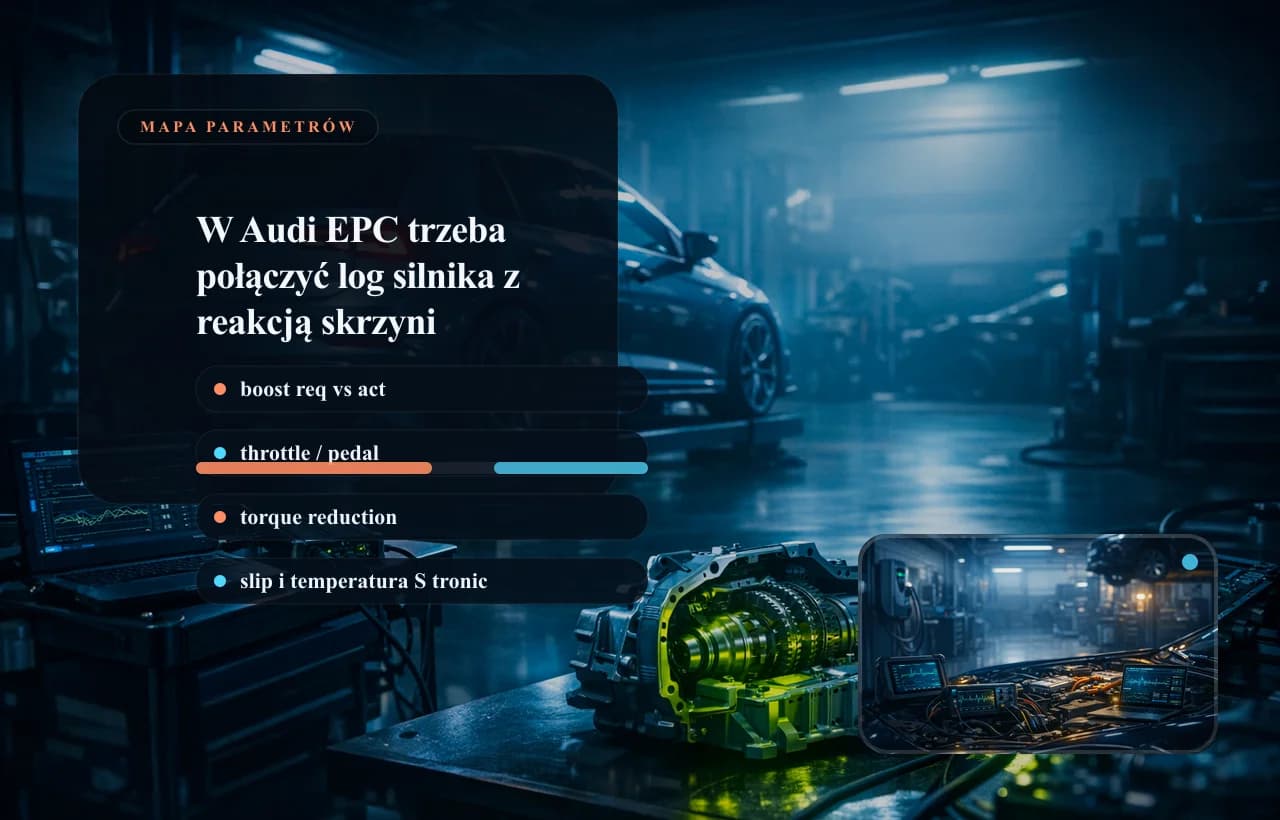
Audi engine compartment with a technician analyzing EPC and S tronic logs on a tablet.

In short: with Audi, you must correlate EPC, boost, and torque control, because a fault code alone is rarely sufficient

If an Audi shows EPC or simply loses power without a clear message, the most important thing is to determine whether the ECU is not executing a request or is itself limiting torque protectively. These are two completely different repair paths.

In practice, you need to see logs of boost, air flow, ignition angles, mixture corrections, and throttle position. Only from this can you distinguish a TFSI problem from a component or adaptation issue.

To organize your method of working with parameters, start with: a general guide to live data.

Zapamiętaj

Komunikat vs dane

Komunikat to dopiero początek. Dane dopiero zaczynają rozmowę.

In an Audi, it's very easy to confuse a driver message with the actual cause of a fault. EPC, loss of power, S tronic jerking, or increased oil consumption in a TFSI are symptoms that only make sense when you see them in measuring blocks and under load.

Audi Loss of Power: Which Parameters to Check First, Before Someone Replaces the Turbo or MAF Sensor?

The phrase 'Audi loss of power' is one of the most common in this topic group, but the symptom itself covers several completely different scenarios. Sometimes the ECU demands higher pressure and doesn't get it, and sometimes it deliberately cuts torque after detecting knocking combustion, overheating, a mixture that is too lean, or an ignition problem.

Therefore, start by looking in parallel at requested and actual boost, MAF or MAP, ignition angles, fuel trims, and throttle position. Without this, a 'loss of power' fault can send you in a completely wrong direction.

Audi A3 EPC Loss of Power: Is the Throttle Body, Ignition, Accelerator Pedal, or Torque Control to Blame?

The query 'Audi A3 EPC loss of power' well illustrates users' problem with interpreting the EPC warning light. This message does not point to a single component. It means that the electronic engine or torque control has detected an inconsistency.

In the data, you need to check the consistency of signals from the accelerator pedal, throttle response, correlation with ignition, and the torque calculated by the ECU. If one of these links falls out of logic, the car enters a protective mode, and the driver only sees EPC and a power drop.

Did you know...Diagnostics

AVILOO to austriacki system certyfikacji baterii EV — test trwa ok. 20 min jazdy i generuje europejski certyfikat SOH akceptowany przez dealerów i ubezpieczycieli.

Read more
Did you know...Operation

Nawet niewielka domieszka oleju PAG w układzie klimatyzacji EV może spowodować "przebicie" izolacji kompresora HV i całkowicie unieruchomić samochód.

Read more

Audi 2.0 TFSI Burning Oil: Which Data Helps Distinguish the Main Symptom from Accompanying Problems?

The phrase 'Audi 2.0 TFSI burning oil' most often leads directly to discussions about an engine overhaul, but before such a costly decision is made, it's worth looking at the accompanying data. Oil consumption can go hand in hand with misfires, mixture corrections, crankcase ventilation issues, and unstable operation under load.

Live data won't disassemble the engine for you, but it allows you to assess whether, besides the oil consumption itself, other things are happening: misfires, incorrect boost pressure, excessively high temperatures, or an anomaly in throttle control.

This is important because without it, it's easy to overlook an additional fault that will still remain in the car after the overhaul.


Typowa pułapka

Koszt błędnej interpretacji

Najdroższa interpretacja zwykle pojawia się za wcześnie.

The phrase 'Audi 2.0 TFSI burning oil' most often leads directly to discussions about an engine overhaul, but before such a costly decision is made, it's worth looking at the accompanying data. Oil consumption can go hand in hand with misfires, mixture corrections, crankcase ventilation issues, and unstable operation under load.

Audi A6 C7 S tronic Jerks When Pulling Away: When Is an Adaptation Enough, and When Do Logs Show Something More Serious?

The query 'Audi A6 C7 S tronic jerks when pulling away' fits well into the problem of dual-clutch transmissions: the symptom can be mechanical, hydraulic, or adaptation-related. The driver's feeling alone doesn't tell you which of these paths is true.

In the data, it's worth looking at transmission temperature, learned values, filling times, clutch slip, and input torque from the engine. Without this correlation, you can unnecessarily quote a mechatronics unit when the real problem is an incorrect contact point or engine behavior when pulling away.

We also break down similar scenarios in the VAG group in the guide: Skoda scenarios with EPC and DSG.

Audi live data panel: EPC, boost, throttle body, and relationship with S tronic.
Audi Logs

EPC is a Collective Message

Only a parallel recording of boost, ignition, fuel, and torque control shows why the Audi cuts power.

How to Interpret Audi Logs So You Don't Condemn a Good Part to Replacement?

In an Audi, one problem very often triggers several subsequent ECU reactions. An intake leak can lower boost, and this can cause mixture corrections, ignition issues, and finally EPC. Whoever looks only at the last code most often hits the effect, not the cause.

Therefore, logs should be read in layers: first air and fuel, then ignition and torque, and only at the end additional protective ECU limitations.

Decision: When Does an Audi Require a Test Drive with Logs, and When Full Brand Diagnostics?

If the EPC came on once, you have a saved freeze frame, and there is no clear power loss, a controlled test drive and log make sense. If the symptom returns, the car cuts power, or the transmission regularly jerks when pulling away, there's no point in guessing.

In that case, the proper path is Audi diagnostics on live data, road logs, and S tronic analysis.

If you're comparing Audi with an approach to similar symptoms in other brands, also read: BMW drivetrain in data.

FAQ: Live Data Audi, EPC and TFSI / S tronic Logs

Does the EPC warning light in Audi always mean a throttle body problem?+

No. EPC is a message regarding electronic engine and torque control. In practice, the cause can be ignition, accelerator pedal, turbocharging, throttle body, pressure sensors, or even adaptations after a repair.

How to distinguish a real S tronic problem from incorrect basic settings?+

You need to check transmission temperature, learned values, clutch slip, pressures, and the conditions under which the symptom occurs. A test drive without logs doesn't tell you whether the mechatronics, clutch, or incorrect adaptation is to blame.

Can an oil-burning Audi 2.0 TFSI be assessed in data before a decision on an overhaul is made?+

You won't see mechanical piston wear directly in the data, but you can assess secondary effects: mixture corrections, crankcase ventilation, misfires, temperatures, and behavior under load. This helps distinguish the main symptom from other accompanying faults.

Should old faults be cleared before logging?+

No. First, record the history and freeze frame, and only then plan a test drive. Clearing data at the start removes context and makes it harder to compare fault conditions.

Which symptoms are worth describing in detail before Audi diagnostics?+

Whether EPC appears cold or after warming up, at what RPM the car loses power, whether the transmission jerks when pulling away or during downshifts, and whether the problem worsens after a long trip or under hard acceleration.

Related services

If you want to verify this, check the service

Consult result