
Hybspec
2026-04-2410 minVerified 2026-04-24Baterie, HV i BezpieczeństwoSeries: Bezpieczeństwo i Standardy

How to choose an insulating mat for HEV/EV work — what not to buy

For hybrids and EVs, an insulating mat is not a workstation decoration. It is a safety element that must work when a person stands near a car with a high-voltage system, moisture, metal bodywork and HV cables. That is why you do not buy it based solely on the phrase "17 kV" or a marketplace category like "flooring." You buy it based on the standard, class, material, marking and a real test document.
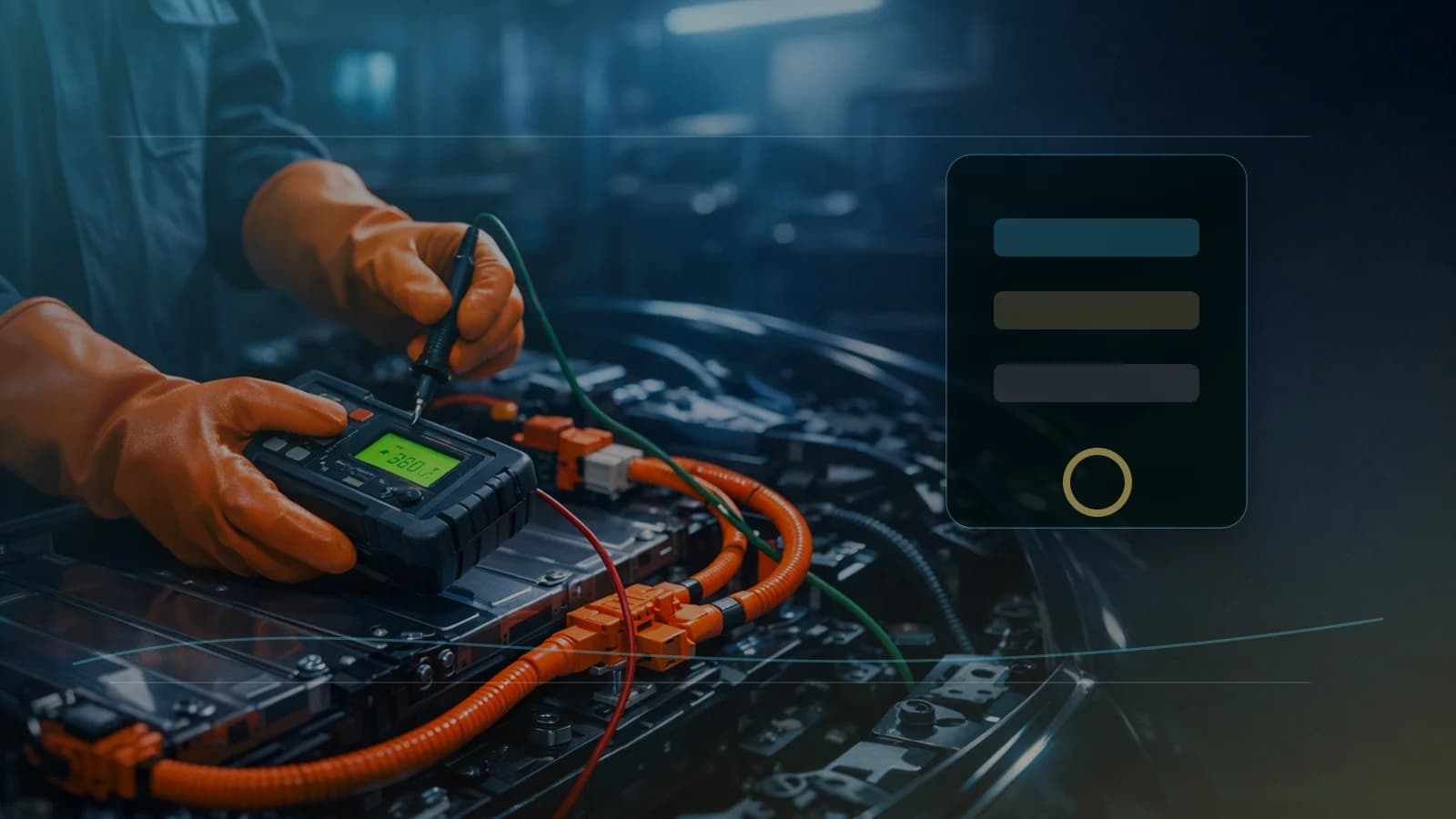
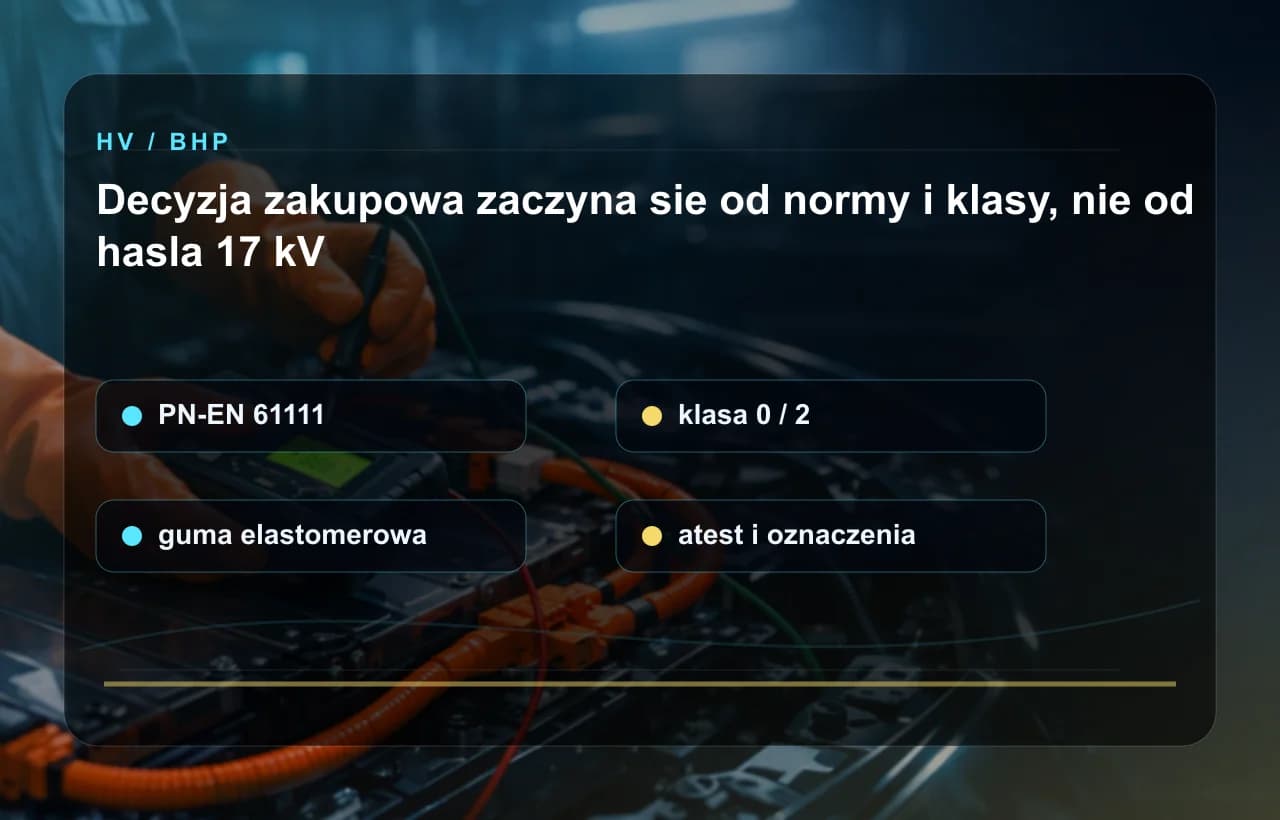
Workstation near a high-voltage system with an insulating mat and measuring equipment.

In short: for HEV/EV, choose a mat with PN-EN/EN/IEC 61111, a class and a test document, not ordinary rubber with a "17 kV" description

The most important question is not: "does the mat have 17 kV?" The most important question is: is this an insulating mat for work on live installations, classified and tested according to PN-EN/EN/IEC 61111.

In store descriptions, three worlds often mix: rubber flooring, anti-slip mats and real electro-insulating equipment. For HEV/EV, we are only interested in the third group, because we work on a system where a procedural error can mean electric shock, car damage or a false sense of safety.

If you also want to understand how we measure the safety of the car itself, see the guide: how to read the 1000V insulation test result.

Zapamiętaj

Bezpieczeństwo pomiaru

W układach HV spokojny pomiar jest cenniejszy niż szybka pewność.

For hybrids and EVs, an insulating mat is not a workstation decoration. It is a safety element that must work when a person stands near a car with a high-voltage system, moisture, metal bodywork and HV cables.

"17 kV" in the flooring category: why is the voltage description alone not enough?

Class 2 in the IEC 61111 family is associated with a working voltage of 17 kV AC. That sounds impressive, but the phrase "17 kV" in the product title alone does not tell you whether the mat complies with the standard, passed testing, has a class marking or if the seller provides documentation.

The problem starts when the product is sold like ordinary industrial flooring: it has thickness, color, an anti-slip structure and a declaration of being "insulating," but no class according to 61111. Then you are buying a surface, not a controlled protective device.

In practice, do not compare "17 kV vs. 1000 V" in isolation from the standard. Compare: standard, class, material, certification, marking, condition and work environment.

Class 0 or class 2 for an electric car and hybrid: how to decide without exaggeration and without risk

Typical HEV/EV systems operate in the range of a few hundred volts, and service work is usually planned as work after disconnecting and securing the HV system. Therefore, a class 0 mat compliant with 61111 is often a logical choice for a workstation up to 1000 V.

Class 2 provides a larger margin and may make sense where the workshop has a wider range of electrical work, an OHS requirement or a workstation for various HV devices. However, it is not a magical substitute for procedure. A thicker and "stronger" mat does not fix the lack of zero-voltage confirmation.

The simplest purchasing filter: if the description does not include the 61111 standard, class, working voltage, material and test document, do not try to guess the class by thickness or price.

  • class 0: usually a sensible starting point for work up to 1000 V, if compliant with 61111
  • class 2: larger voltage margin, but greater weight and cost
  • no class: product is disqualified regardless of how the marketing description sounds
Process of choosing an insulating mat: standard PN-EN 61111, class, material and certification.
PN-EN 61111

Purchasing decision: first the standard and class, only then the voltage from the description

For HEV/EV, the biggest mistake is buying an "insulating mat" without confirmation that it is electro-insulating equipment for work on live installations.

Did you know...Makes & Platforms

Charakterystyczny "wyjec" w Toyota HSD przy podjeździe pod górę to normalne zjawisko — e-CVT utrzymuje silnik spalinowy na stałych obrotach, a MG2 rozkręca się do 10 000 RPM.

Read more
Did you know...High Voltage

Układ HV w EV/HEV używa "masy pływającej" — obwód wysokiego napięcia jest całkowicie odizolowany od karoserii. Gdy izolacja spadnie poniżej 100 Ω/V, BMS natychmiast odcina zasilanie.

Read more

Rubber, elastomer or PVC: what should an insulating mat be made of?

Standard 61111 applies to insulating mats made of elastomer, i.e., in practice rubber or elastomer compound materials. Therefore, when buying, we look for a rubber/EPDM/SBR mat with declared compliance, not any PVC roll described as insulating.

PVC can be useful as a floor covering, mechanical protection or workstation organization element, but without an electro-insulating class it should not be treated as a barrier for HV work. This is especially important in mobile service, where the ground can be wet, cold or uneven.

If the mat has additional features such as oil resistance, acid resistance, UV resistance or an anti-slip structure, treat them as extras. The core of the decision remains the same: standard, class, certification and surface condition.

Typowa pułapka

Typowy błąd

Tu większym problemem niż błąd bywa zbyt lekka ręka do tematu.

Standard 61111 applies to insulating mats made of elastomer, i.e., in practice rubber or elastomer compound materials. Therefore, when buying, we look for a rubber/EPDM/SBR mat with declared compliance, not any PVC roll described as insulating.

What not to buy for HEV/EV work: a quick red flag list

The most risky products are those that look professional but have no trace of electrical testing. Black ribbing, 3-5 mm thickness and the note "dielectric" are not yet proof that the mat is suitable for HV work.

Reject a product if the seller cannot show a technical data sheet, standard, class and test document. Also reject a used mat with an unknown history, cut, cracked, with worn markings or stored for years in sunlight and oil.

This is not a place for savings similar to buying a workshop mat. With HV, a cheap product without traceability can be worse than no product at all, because it gives false confidence.

  • no PN-EN/EN/IEC 61111 in documentation
  • no class 0/1/2/3/4 and no markings on the mat
  • "17 kV" description without certification and without information on the test method
  • PVC, ESD, anti-fatigue or anti-slip as the only declaration
  • used, damaged mat or one without storage history

What to check upon delivery of the mat before it goes under the car?

After purchase, do not immediately stash the mat in the service vehicle. Check the markings on the underside or surface, class compliance with the document, batch number, edge condition, cracks, conductive contamination and whether the surface is sticky or perished.

It is also worth establishing your own visual inspection schedule. A mat that has been folded, cut with a knife, soaked in oil or worked on sharp concrete may need to be withdrawn, even if it has a good class on paper.

We apply the same way of thinking to car components. Before installing an HV component, it is worth first performing an insulation test of the inverter, charger or cable before installation, instead of putting an unknown into the system.

An insulating mat does not replace the HV procedure, gloves and zero-voltage measurement

The most dangerous mistake is thinking: "I have a mat, so I can work." The mat is only one layer of protection. With HEV/EV, you still need the manufacturer's procedure, system disconnection, protection against re-energization, zero-voltage confirmation, insulated tools and appropriate gloves.

If the issue involves a real car with an insulation fault, moisture, collision or a component after disassembly, the mat alone decides nothing. Then you need measurement and result interpretation, i.e., an HV 1000V insulation test.

In service work, the complete package counts: protective equipment, procedure, measurement and a person who understands the limitations of each element. We also wrote about the formal side of competence in the article about SEP and F-gas certificates in hybrid service.

FAQ: insulating mat for HEV/EV

Is a class 0 mat sufficient for HEV/EV work?+

Often yes, if we are talking about typical work up to 1000 V and the mat complies with PN-EN/EN/IEC 61111. The decision, however, depends on the procedure, system voltage, work environment and OHS requirements.

Is a 17 kV mat always better than class 0?+

Not always. Class 2 provides a higher voltage margin but is heavier, more expensive and does not replace the HV procedure. For HEV/EV cars, what matters more is whether the mat has the correct standard, class and a current test certificate.

Is a PVC mat suitable as an insulating mat for an electric car?+

PVC alone or the label "insulating" is not enough. For work on live installations, look for an elastomer/rubber mat compliant with PN-EN/EN/IEC 61111, with a class marking and certification.

What should you not buy as a mat for high-voltage work?+

Do not buy a product without the 61111 standard, without a class, without markings on the mat, without a test document, with only a "17 kV" description, or from a category like flooring/anti-slip/ESD without electro-insulating confirmation.

Does an insulating mat replace gloves, qualifications and the HV disconnection procedure?+

No. The mat is an additional barrier. It does not replace gloves, insulated tools, confirmation of zero voltage, the manufacturer's procedure or the competence of the person performing the work.

Related services

If you want to verify this, check the service

Consult result