2026-03-02 • 8 minLive Data i Diagnostyka
How to Read 1000V Insulation Test Results in an EV?
Insulation faults are often mistaken for battery failure. Yet the culprit can be a completely different component.
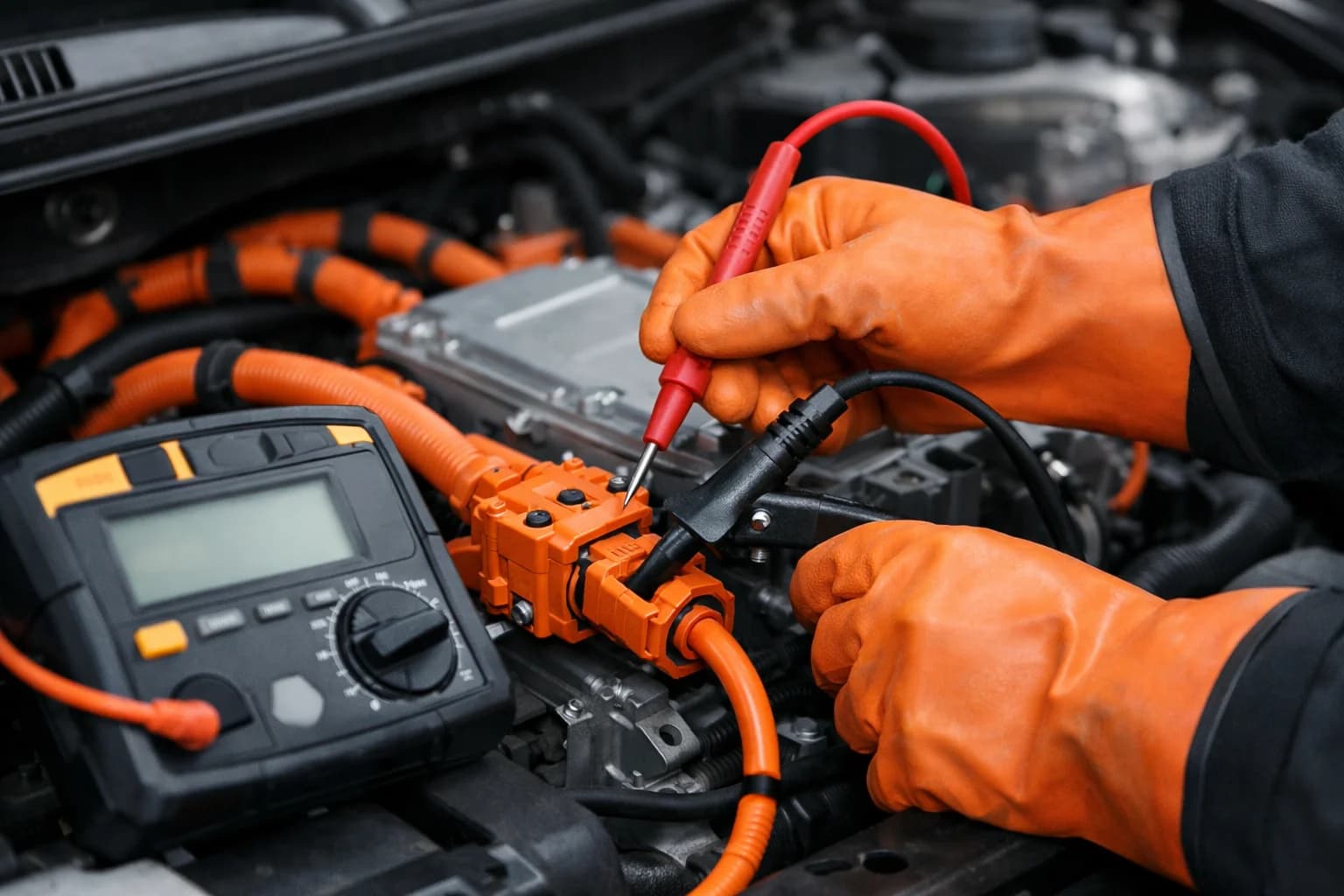

Insulation faults are often mistaken for battery failure. Yet the culprit can be a completely different component.
An HV insulation test measures the resistance between the high-voltage circuit and the bodywork. High resistance = isolated and safe system. Low resistance = risk of breakdown and HV cut-off by safety systems.
This is not a 'battery test'. Often the culprit is an HV cable, connector, air conditioning compressor, or a post-collision component.
Always read the result in context (moisture/rain, collision, AC service) and only then locate the source of the breakdown.
Bezpieczeństwo pomiaru
W układach HV spokojny pomiar jest cenniejszy niż szybka pewność.
Insulation faults are often mistaken for battery failure. Yet the culprit can be a completely different component.
It is the resistance between the high-voltage circuit and the vehicle's ground. The higher it is, the safer the system.
A drop below the manufacturer's threshold triggers protective strategies and drive cut-off.
The most common causes are damaged cables, flooding, a faulty compressor, or errors after collision repair.
That is why simply replacing a 'suspected' part without measurement can be expensive and ineffective.
If the problem only appears 'after rain', you are most likely dealing with a micro-crack in the insulation or moisture in a connector — and this can be detected through measurement.
Układ HV w EV/HEV używa "masy pływającej" — obwód wysokiego napięcia jest całkowicie odizolowany od karoserii. Gdy izolacja spadnie poniżej 100 Ω/V, BMS natychmiast odcina zasilanie.
Read more→Standard ECE R100 wymaga minimum 100 Ω na każdy volt napięcia DC i 500 Ω/V dla AC. Dla systemu 400V to minimum 40 kΩ rezystancji izolacji.
Read more→If the result is consistently low (when dry), the breakdown is usually hard and easier to locate — because it does not depend on conditions.
If the result drops only after rain or a car wash, the problem is often in a place that catches water: a wiring harness, connector, area around the compressor, or a post-collision component.
In such cases, these guides are also helpful: insulation fault after collision and HV insulation after a crash.

A Result Without Context Is Worth Little
This diagram shows the differences between a hard short, a conditional fault after rain, and a stably isolated system.
Typowy błąd
Tu większym problemem niż błąd bywa zbyt lekka ręka do tematu.
If the result is consistently low (when dry), the breakdown is usually hard and easier to locate — because it does not depend on conditions. If the result drops only after rain or a car wash, the problem is often in a place that catches water: a wiring harness, connector, area around the compressor, or a post-collision component.
After a collision, flooding, or sudden appearance of an HV message. In such situations, continuing to drive without diagnostics can worsen the problem.
The most sensible step is to perform an insulation test before further use.
If the fault returns after clearing or appears conditionally (rain/car wash) — it is almost always a physical problem: moisture, micro-crack in insulation, connector, or component.
First, confirm the MΩ level through measurement and locate the circuit that is 'pulling' the result down. Only then does it make sense to decide on repair or part replacement.
If you need a 'hard' result and breakdown location: HV 1000V insulation resistance test.
FAQ: HV Insulation Resistance in Practice
Results are given in megaohms (MΩ). Minimum safety standards (e.g., ECE R100) require resistance of at least 100 Ω per volt of system voltage for DC circuits and 500 Ω/V for AC circuits. In practice, a healthy and dry HV system in an EV often shows insulation levels from several to even tens of megaohms.
This is a classic symptom of micro-cracks on orange HV cables or micro-leaks in connectors. When dry, air acts as a sufficient insulator. Water mixed with road salt is an excellent conductor — driving through a puddle closes the circuit between a cracked cable and the bodywork, causing an immediate drop in resistance and locking the car.
Definitely not. A standard multimeter powers measurement circuits with only 9V, which cannot 'break through' micro-damage. A professional megohmmeter pushes real high voltage of 500V or 1000V into the tested circuit, simulating actual operating conditions of the installation.
Szukanie przebić do masy po kolizjach, zalaniach i błędach systemu hybrydowego.
Precyzyjny odczyt SOH, test inwerterów i rozwiązywanie problemów z zasięgiem.