
Hybspec
2026-03-258 minBaterie, HV i BezpieczeństwoSeries: Diagnostyka / Izolacja HV

HV insulation test before installing an inverter, charger or cable: why it's done even before starting the car

In practice, the most expensive scenario is when a component is already bolted in, harnesses are connected, the car is assembled, and only then an insulation fault or no READY appears. That's why an HV insulation test makes sense not only after a collision or flooding. It's often worth performing it also before installing an inverter, OBC charger, compressor or high-voltage cable, especially when the part was used, stored after an accident, or comes from another vehicle.
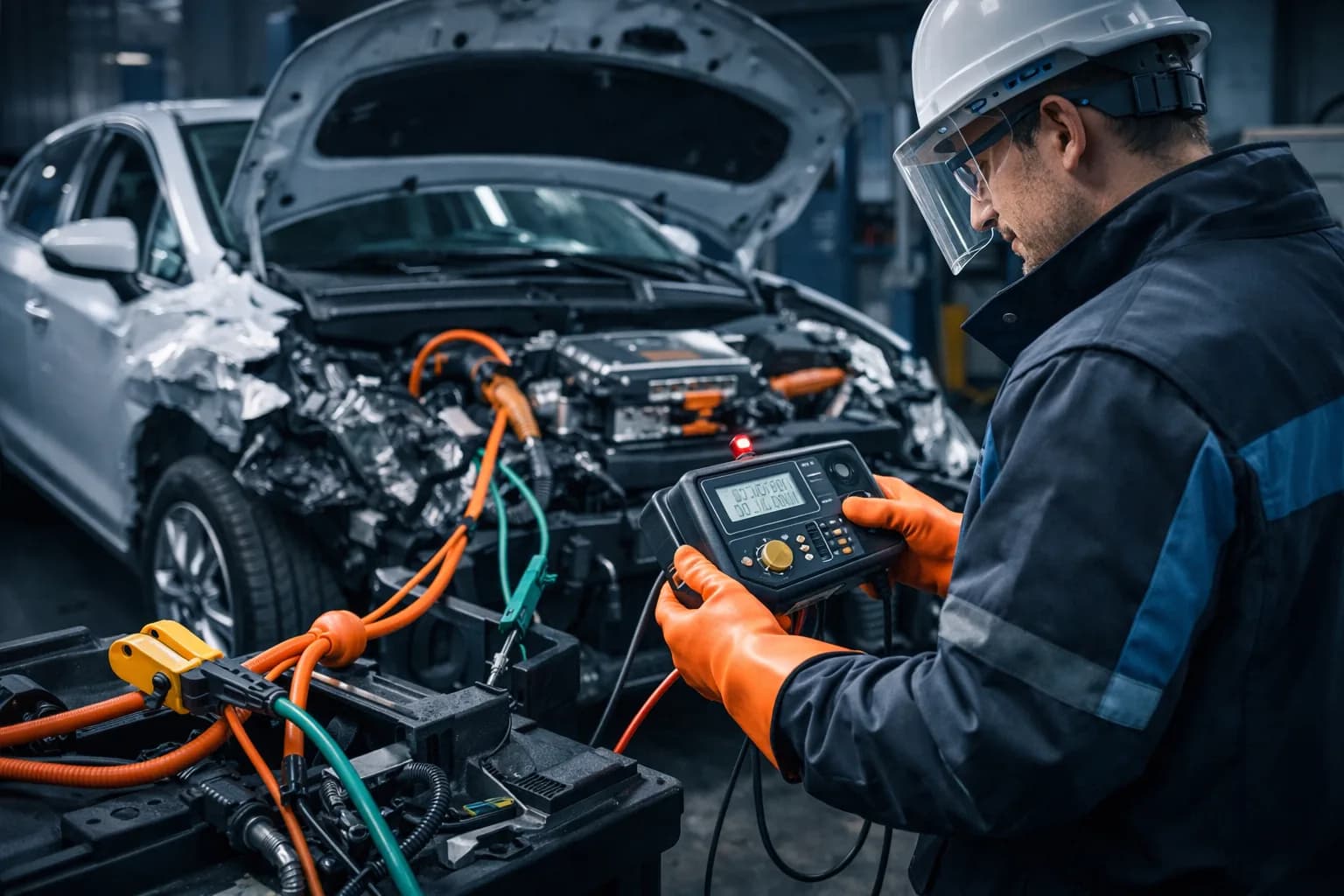

HV insulation measurements before installing a high-voltage component.

In short: an insulation test before installation checks whether you'll bring a problem into the HV system along with the part

This is exactly the moment when the measurement has the greatest economic value. The component is still outside the car, so it's easy to isolate it from the rest and check whether the insulation resistance holds a safe level.

If the result is bad, you don't have to disassemble half the car a second time. That's precisely why this procedure complements the HV 1000V insulation measurement performed in the car.

Zapamiętaj

Bezpieczeństwo pomiaru

W układach HV spokojny pomiar jest cenniejszy niż szybka pewność.

In practice, the most expensive scenario is when a component is already bolted in, harnesses are connected, the car is assembled, and only then an insulation fault or no READY appears. That's why an HV insulation test makes sense not only after a collision or flooding.

Inverter, OBC charger, cable, compressor, heater: when does such a test give the most?

It's most justified where the component works directly in the HV circuit and its failure can immediately block the car's readiness. In practice, this applies to inverters, onboard chargers, HV cables, compressors, and PTC heaters.

It makes even more sense for parts from disassembly, after transport, after repair, after a collision, or when someone doesn't have the full storage history of the component.

Did you know...Diagnostics

Testy aktywne (np. włączenie wentylatora z testera) pokazują tylko, że komponent odpowiada na sygnał — nie mówią nic o tym, czy działa prawidłowo pod obciążeniem.

Read more
Did you know...Batteries

Baterie LFP (np. BYD Blade Battery) powinny być ładowane do 100% co najmniej raz w tygodniu — to pozwala BMS prawidłowo zbalansować napięcia w celach.

Read more

What does such a test detect, and what won't it tell you about the component?

It primarily detects leakage and a drop in insulation relative to ground. This tells you whether the part is electrically safe and whether it will introduce an insulation fault right after the car is assembled.

It won't tell you, however, whether the component's controller has correct coding, whether the cooling system works properly, or whether the control logic is consistent. That still requires HV diagnostics based on data and measurements.

Sequence diagram: component, insulation test, installation decision.
UT511

The cheapest moment to find a leak is before installation

If a faulty component already ends up in the car, you then pay again for disassembly, finding the cause, and further work.

Typowa pułapka

Typowy błąd

Tu większym problemem niż błąd bywa zbyt lekka ręka do tematu.

It primarily detects leakage and a drop in insulation relative to ground. This tells you whether the part is electrically safe and whether it will introduce an insulation fault right after the car is assembled.

Why can a component look good and still fail an insulation test?

Because some damage isn't spectacular. A micro-crack in the casing, moisture at the connector, a fatigued seal, or a trace of improper service can lower insulation without a striking visual sign.

The same applies to HV A/C components after poor service. If the topic touches on the compressor or refrigerant circuit, it's worth also checking the safe EV and HEV A/C service procedure.

Decision: when to perform such a test mandatorily, and when as a risk safeguard

Mandatorily when the car had an insulation fault, a collision, flooding, or you're installing a part with uncertain history. As a very sensible safeguard also when the component is expensive to install and its re-removal would be costly in time or logistics.

If you want to understand how we interpret the result in megaohms, also read the guide on 1000V insulation test thresholds.

FAQ: HV insulation test before installation

Does an insulation test make sense if the component is new or looks good?+

Yes. Insulation isn't just about the casing's appearance. The problem can lie in a micro-crack, moisture, a connector, a seal, or a cable that electrically doesn't hold the parameter despite looking correct.

Which components are worth checking before installation?+

Most often the inverter, OBC charger, HV A/C compressor, PTC heater, HV cables, and components after transport or body repair.

Does such a test replace controller diagnostics?+

No. An insulation test answers whether the circuit is safely isolated from ground. It does not replace diagnostics of control logic, live data, or verification of controller communication.

Does a used part from disassembly always require such a check?+

Not always, but very often it's the most sensible move. Especially when the part's history is incomplete or the donor vehicle had a collision, flooding, or long storage.

Related services

If you want to verify this, check the service

Consult result