
Hybspec
2026-03-0210 minBłędy, Objawy i AwarieSeries: Błędy i Awarie

Isolation Fault After a Collision: Why Did Your Hybrid "Die"?

You bought a slightly damaged hybrid from the US or Europe. Airbags intact, radiators untouched, only the fender and headlight damaged. You press the START button, but the hybrid car won't start, and a critical system error message appears on the dash. What happened? The car is protecting you from electric shock.
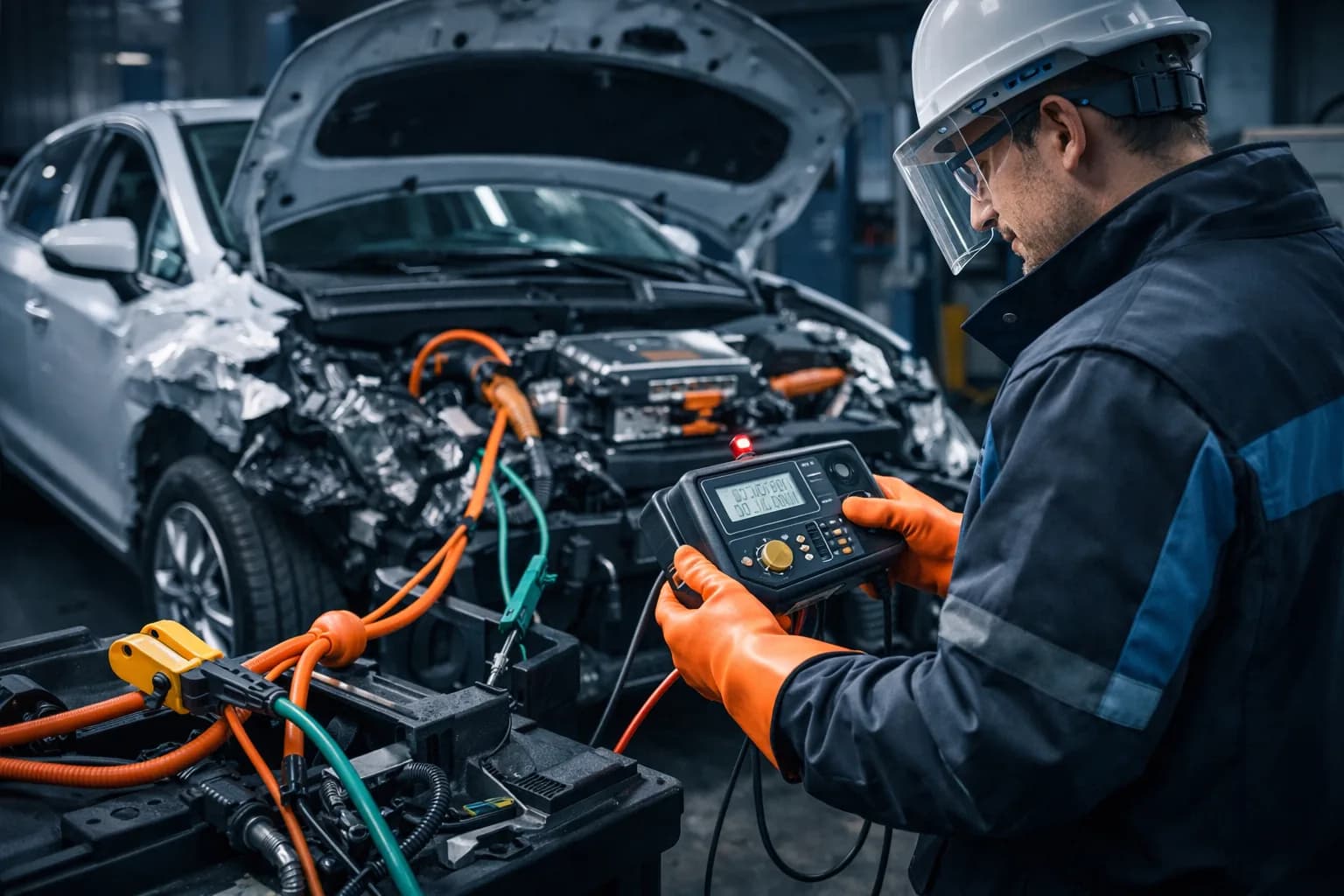
Auto po kolizji podczas pomiaru izolacji 1000V.

In short: after a collision, the car may “cut HV” due to a drop in isolation — and that is correct protection

Not every hybrid car workshop knows this: in an EV/HEV, the high-voltage system operates on a so-called floating ground. If current starts to “leak” to the body, the car opens the HV battery contactors and blocks READY.

After a fender bender, a breakdown rarely means a “dead battery.” Most often, the problem lies in the peripherals: HV cables, connectors, the AC compressor, PTC heater, or inverter.

Instead of clearing codes, you need to measure the isolation resistance and locate the circuit that is causing the low reading.

Zapamiętaj

Bezpieczeństwo pomiaru

W układach HV spokojny pomiar jest cenniejszy niż szybka pewność.

You bought a slightly damaged hybrid from the US or Europe. Airbags intact, radiators untouched, only the fender and headlight damaged.

Floating Ground in EV/HEV: How the Car Detects a Breakdown to the Body

In a traditional car, the body is the negative terminal for the 12V battery. In high-voltage (HV) systems, the cables carrying 300V-800V are completely isolated from the car's metal chassis, meaning they operate on a so-called floating ground.

The car's computer (BMS / hybrid controller) constantly monitors the electrical resistance between the HV cables and the body. If the resistance drops drastically and current begins to leak to the chassis, the system cuts power from the traction battery in a fraction of a second.

Why Does Isolation Fail After a Minor Collision? (Typical Breakdown Points)

The damage does not have to involve the traction battery itself. In practice, the problem most often appears on the peripherals and cables outside the HV pack.

A slight deformation of the crumple zone, moisture, or a chafed wiring harness is enough for the isolation resistance to drop below the safety threshold.

If the car is an import, also see the variant “moisture + transport”: HV isolation faults after a collision (USA).

  • Crushed AC compressor (often located near the crumple zone).
  • Chafed orange HV cables against sharp, deformed sheet metal edges.
  • Damage to the PTC heater (cabin heater) powered by high voltage.
  • Leaking connectors allowing moisture ingress.
Did you know...High Voltage

Układ HV w EV/HEV używa "masy pływającej" — obwód wysokiego napięcia jest całkowicie odizolowany od karoserii. Gdy izolacja spadnie poniżej 100 Ω/V, BMS natychmiast odcina zasilanie.

Read more
Did you know...High Voltage

Standard ECE R100 wymaga minimum 100 Ω na każdy volt napięcia DC i 500 Ω/V dla AC. Dla systemu 400V to minimum 40 kΩ rezystancji izolacji.

Read more

OBD2 vs. Physics: How to Locate a Breakdown (Not Just Clear the Message)

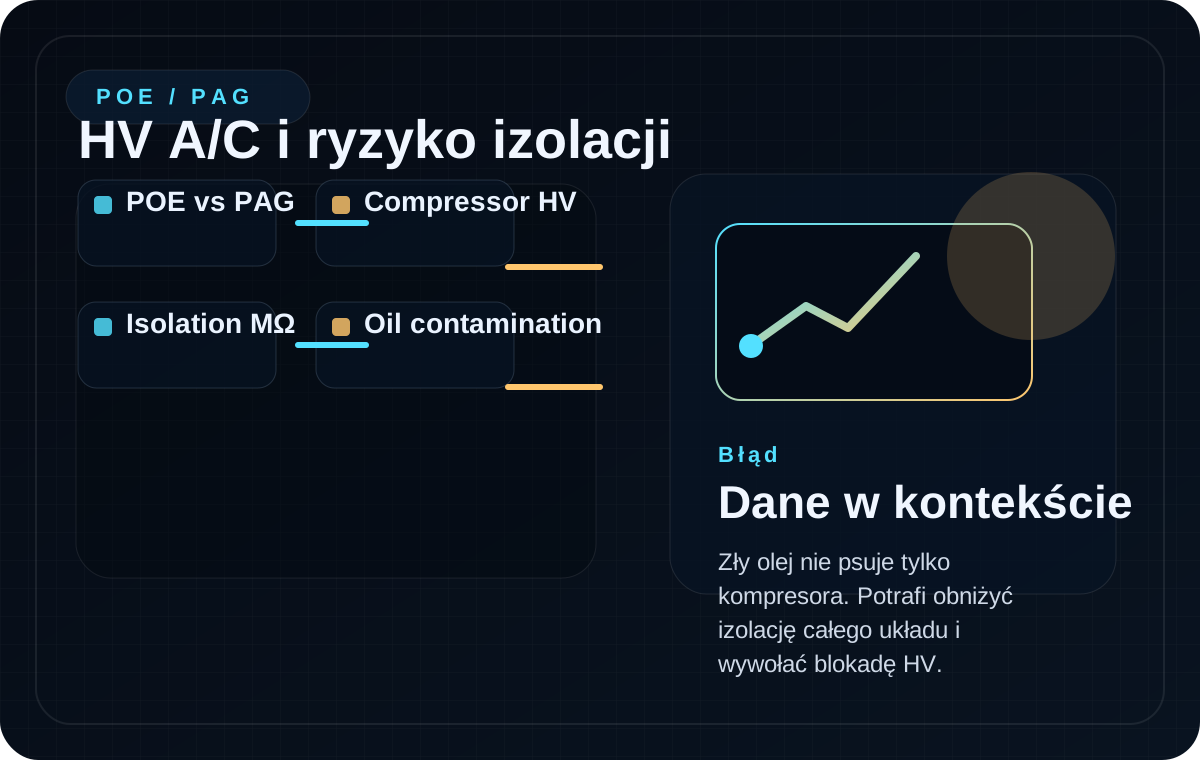
Diagram showing the relationship between POE/PAG oil, the HV compressor, and the isolation test result.
Isolation Diagram

Measure First, Decide Later

The diagram shows the diagnostic logic after a collision: from isolating circuits, through the 1000V test, to pinpointing the source of the breakdown.

An average mechanic might plug in a scan tool and clear the crash data error. However, if the cable is still touching the body or the insulation is damaged, the error will return immediately, and in extreme cases, a dangerous short circuit can occur.

That's why diagnosis starts with physics, not clearing warning lights. We remove the Service Plug, isolate the circuits, and apply a test voltage of 500V or 1000V using a professional megohmmeter to the de-energized system. Only this way can you measure resistance down to thousandths of a megohm and pinpoint the faulty component.

Typowa pułapka

Typowy błąd

Tu większym problemem niż błąd bywa zbyt lekka ręka do tematu.

An average mechanic might plug in a scan tool and clear the crash data error. However, if the cable is still touching the body or the insulation is damaged, the error will return immediately, and in extreme cases, a dangerous short circuit can occur.

Checklist Before Restarting an EV/HEV After a Collision

Before you start “force-starting” the car and resetting modules, make sure the problem is not an active HV breakdown.

If you don't have experience working with HV, do not risk taking measurements yourself — the system can have several hundred volts, and an isolation fault means safety is already compromised.

  • Do not clear codes as a “first step” — first locate the circuit causing the low isolation.
  • Check the area around the crumple zone for damaged HV cables/connectors or flooded modules.
  • If the AC was serviced after the collision, consider the risk of PAG vs. POE oil (HV compressor).
  • Only after restoring isolation and checking HV logic does it make sense to perform resets/adaptations.

Decision: What's Next (To Get the Car Back on the Road and Keep It Safe)

If the isolation result is correct but the car still won't enter READY — only then do we move on to diagnosing controllers and logs (Crash Data, lockouts, “permanent DTCs”).

If the isolation is too low — the priority is locating the breakdown and repairing the circuit, not “force-unlocking.”

In practice, the fastest way to get a result is a HV isolation test 1000V.

Frequently Asked Questions About High-Voltage Isolation Faults

Does an isolation fault mean the entire traction battery is damaged?+

Very rarely. Most often, the battery protects itself by opening the contactors. The breakdown typically occurs in external circuits — on the cables going to the inverter, the AC compressor, or in the electric motor itself.

What should the correct isolation resistance be in an EV/HEV?+

Exact values depend on the manufacturer and the system's nominal voltage, but as a general, safe industry rule (e.g., per ECE R100 standards), a minimum of 100 ohms per volt for DC systems and 500 ohms/V for AC is accepted. Higher values indicate excellent isolation.

The car started after clearing the crash data errors. Is it safe to drive?+

You should not do this without performing a megohmmeter measurement. The electronics may have reset the lockout, but if a micro-damage to the insulation remains (e.g., a slightly chafed cable), on a rainy day or after driving through a puddle, the resistance could suddenly drop, causing abrupt vehicle immobilization while driving.

Related services

If you want to verify this, check the service

Consult result