
Hybspec
2026-02-289 minVerified 2026-03-30Błędy, Objawy i AwarieSeries: Błędy i Awarie

PAG vs POE in Hybrid and EV. A Mechanic's Mistake That Costs $3,800

In the world of electromobility and hybrid vehicles (EV/HEV), servicing the air conditioning is no longer a simple gas refill. It's an intervention in the cooling system of critical components, including the traction battery.
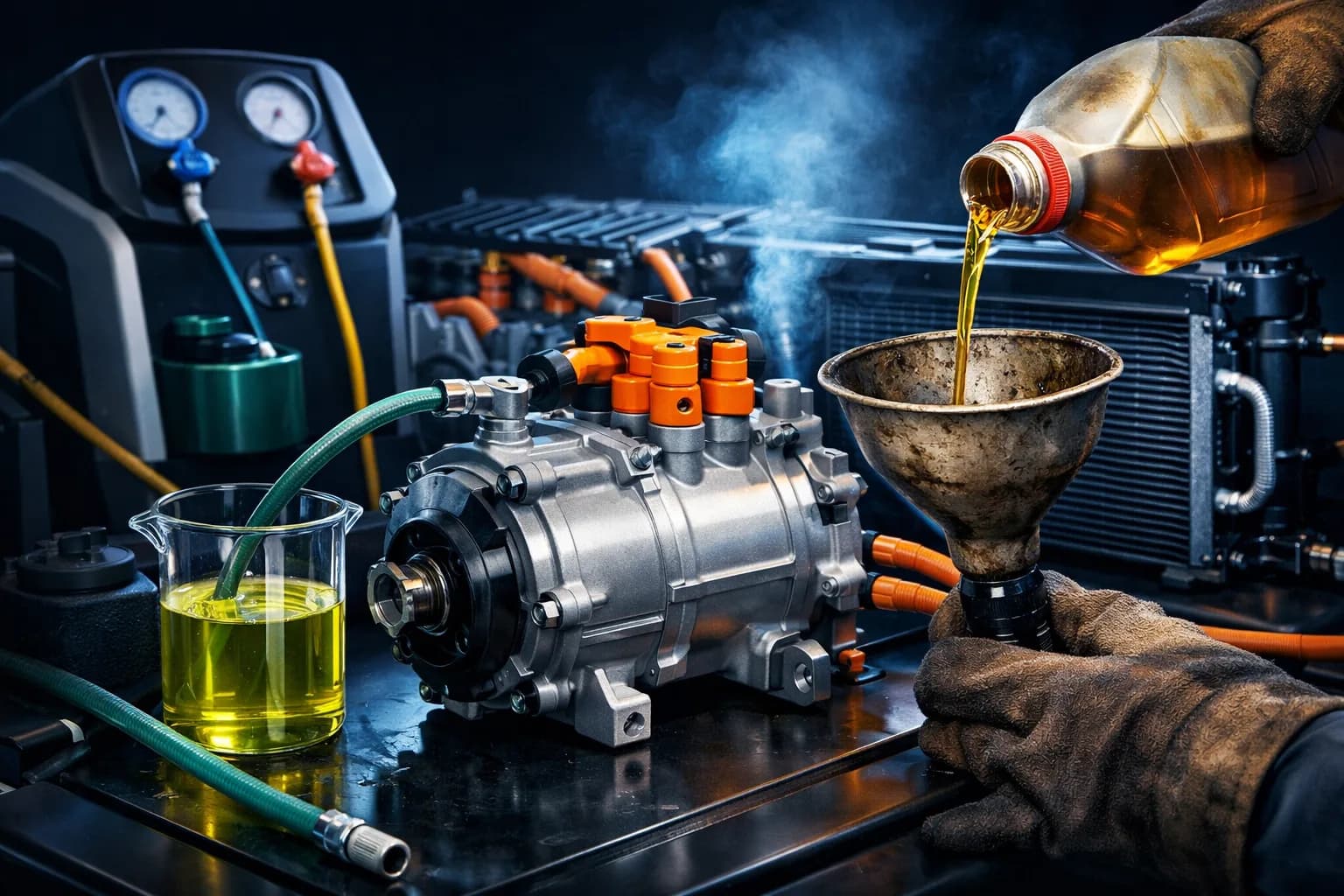
Kompresor wysokiego napięcia i układ klimatyzacji EV.

In short: PAG oil in EV/HEV can lower insulation and kill the high-voltage compressor

In hybrids and electric cars, the AC compressor is powered by the traction battery (HV), so the oil in the system must be a dielectric (e.g., POE / ND-Oil 11), not conductive PAG.

A service error often doesn't look like an "AC problem," but like an HV error: "Check Hybrid System," "Isolation Fault," or a missing READY state.

If you want to understand what exactly is measured in such situations, also see: how to read MΩ thresholds in an insulation test.

Zapamiętaj

Objaw vs przyczyna

Pierwszy winny z listy błędów rzadko bywa tym właściwym.

In the world of electromobility and hybrid vehicles (EV/HEV), servicing the air conditioning is no longer a simple gas refill. It's an intervention in the cooling system of critical components, including the traction battery.

Symptoms after AC service: "Check Hybrid System," isolation fault, and no READY

The typical scenario looks innocent: a cheap "AC recharge" service, after which the car works fine for a moment, then starts throwing hybrid system errors or cuts off HV for safety reasons.

This isn't "electronic magic" — it's the system's reaction to a drop in insulation resistance, often caused by the wrong oil or cross-contamination in the service station's hoses.

Why the compressor in a hybrid/EV operates on high voltage (and why the oil is critical)

Spring arrives, it gets warm. You decide to "fumigate and recharge" the AC in your hybrid. You choose the shop around the corner because they have a promotion for $40. You leave satisfied with cool cabin air, but two days later, a red "Check Hybrid System" message lights up on the dashboard, and the car stops dead. What just happened? A regular mechanic just "cooked" your high-voltage compressor.

In many EVs, the AC is also part of the traction battery's thermal management system. This is another reason why "wrong oil" can trigger an expensive chain reaction.

Did you know...Operation

Nawet niewielka domieszka oleju PAG w układzie klimatyzacji EV może spowodować "przebicie" izolacji kompresora HV i całkowicie unieruchomić samochód.

Read more

The compressor in an EV/HEV is not the same as the compressor in an old diesel (belt vs. HV motor)

In a traditional combustion car, the AC compressor is driven by a V-belt directly from the engine. It's pure mechanics.

In hybrids (e.g., Toyota, Lexus) and fully electric cars (Tesla, BYD, MG), the AC compressor is a completely different beast. It has an integrated electric motor powered by DC current from the main traction battery at high voltage (often exceeding 300V).

The windings of this motor are directly bathed by the refrigerant and lubricating oil. And here's where the problem begins.

PAG conducts and absorbs moisture, POE is a dielectric — this is the key difference

Standard AC service machines dispense PAG (Polyalkylene Glycol) oil into the system. This oil lubricates traditional compressors well, but it has one fatal characteristic for electric cars: it conducts electricity very well and absorbs moisture from the environment.

High-voltage compressors in EVs and HEVs require completely different lubrication. They use POE (Polyol Ester) oil or specialized oils from the ND-Oil 11 series. These are dielectric oils, meaning they behave as insulators.

In practice, it's not about "whether the AC cools," but whether the HV system maintains safe insulation resistance. That's why diagnostics after AC service often include a 1000V insulation test.

Typowa pułapka

Typowa pułapka

Jeśli diagnoza jest szybsza niż pomiar, zwykle jest też za droga.

Standard AC service machines dispense PAG (Polyalkylene Glycol) oil into the system. This oil lubricates traditional compressors well, but it has one fatal characteristic for electric cars: it conducts electricity very well and absorbs moisture from the environment.

Cross-contamination: a small admixture of PAG is enough for the HV system to react (chain reaction)

It's enough for a mechanic to use hoses from an AC station that just recharged an old diesel. Even a small admixture of PAG oil in a POE system (on the order of a few percent) drastically lowers the compressor's insulation resistance — the exact threshold depends on the compressor design and operating voltage, but EV workshops report failures even with minimal contamination.

Here's what happens in your car's code:

  • Conductive PAG oil creates a "bridge" between the high-voltage motor winding and the metal compressor housing.
  • High voltage "leaks" to the vehicle's body (a so-called breakdown).
  • The main computer (BMS/Inverter) immediately detects the drop in insulation resistance.
  • A safety protocol is triggered: the high-voltage contactors are opened.
  • The car is completely immobilized to prevent electric shock to passengers.

What a safe EV/HEV AC service should look like (workshop checklist)

If you're taking an EV/HEV for AC service, treat it like working on an HV system: procedure, oil separation, and breakdown risk control matter.

In practice, the key is whether the service has a real "anti-contamination" process, not just a declaration on the receipt.

  • Separate station / separate hoses for dielectric oil (POE / ND-Oil), not "the same machine as for diesel."
  • Clear information about the oil type and flushing procedure (if the car's history is uncertain).
  • Insulation risk check after service (minimum: informed diagnostics, and if suspicion arises — an insulation test).
  • HV and F-gas qualifications (this isn't a formality, it's a process level).

Decision: what to do when you don't know what oil is in the system (or the error has already appeared)

If you don't have 100% certainty about the service history, don't "top off" anything blindly and don't expect clearing codes to solve the problem — an insulation fault returns because it's physical.

Practically, you have three paths: (1) preventive flushing and correct POE service, (2) insulation test and fault location, (3) stop driving if the car cuts HV or shows an isolation fault.

For full risk diagnostics, choose: insulation measurement with a 1000V megohmmeter.

Frequently Asked Questions About AC Oil in Hybrids and EVs

Why is a different oil (POE) used for air conditioning in hybrids and electric cars than in combustion cars (PAG)?+

Compressors in electrified vehicles (EV/HEV) are driven by internal high-voltage electric motors (often above 400V), and their windings have direct contact with the cooling oil. POE (polyester) oil has dielectric properties, meaning it is an insulator and does not conduct electricity. Standard PAG oil from combustion cars strongly absorbs moisture and becomes a conductor, which in an electric compressor would lead to a short circuit and breakdown.

What happens if a mechanic mistakenly fills my hybrid's system with regular PAG oil?+

Injecting conductive PAG oil into an electric compressor instantly lowers the insulation resistance of the entire high-voltage system. The battery management system (BMS) immediately detects this breakdown and, for safety reasons, blocks the drive from starting (an HV system isolation fault will appear on the dashboard). Repairing this fault requires multiple, very expensive flushing cycles of the entire AC system to remove the contamination.

Can even trace amounts of PAG oil harm a system with POE oil?+

Yes. This phenomenon is called cross-contamination. Even a small amount of PAG oil left in the hoses of a service machine after a previous combustion car can degrade the insulating properties of the POE oil enough for the high-voltage system to throw an error. Therefore, professional electric and hybrid vehicle service centers use specially designated machines or hoses exclusively for handling refrigerant with dielectric oil.

Does every "hybrid" absolutely require POE oil?+

Most full hybrids (HEV) and plug-in hybrids (PHEV) have an electric compressor and require POE oil. Exceptions are some so-called mild hybrid (MHEV) systems or very early hybrid vehicle designs where the AC compressor is still driven by a classic V-belt from the combustion engine. The type of oil used must always be verified against the specific vehicle's technical specifications before starting service.

Will PAG oil damage a hybrid compressor immediately after the system is recharged?+

It doesn't always happen in a split second. It all depends on the concentration of the "bad" oil. Sometimes the system immediately registers the breakdown and locks the car while still in the workshop. Other times, the moisture and PAG oil slowly degrade the winding insulation, and the "Check Hybrid System" error appears after a few weeks of driving in hot weather.

Is it safe to "top up" the AC in a hybrid myself using a can?+

We absolutely advise against it. Ready-made "do-it-yourself" refrigerant cans often contain universal sealants and lubricating oils (including PAG), which conduct electricity very well. Using them in high-voltage vehicles (EV/HEV) is a direct path to destroying a compressor worth several thousand dollars.

I bought a used hybrid. How can I check what oil is in the AC system?+

Unfortunately, from the outside (or from the level of a standard diagnostic computer), it is impossible to determine the type of oil used. If you are not sure about the vehicle's service history, the only safe course of action is to perform a high-voltage system insulation resistance test (e.g., with a Uni-T UT511 megohmmeter) or a preventive, deep system flush and refill with certified POE dielectric oil.

Related services

If you want to verify this, check the service

Consult result