
Hybspec
2026-04-2411 minVerified 2026-04-24Zakup i Weryfikacja

How much does a reliable PHEV charging socket test really cost?

The cheapest 'charging socket test' for a PHEV usually costs as much as a few minutes with a random cable. The problem is that such a test only answers whether the car reacted to the plug. A reliable diagnosis must check the Type 2 port, lock, CP/PP communication, OBC behavior with adjustable current, installation response, and the residual current device with 6 mA DC detection. That's a completely different scope of work.
Mobile Type 2 port test in a PHEV with charger, OBC diagnostics and safety check.

In short: a reliable PHEV charging socket test costs more than a quick cable plug-in because it checks the entire AC path

If someone promises a 'charging test' for the price of a symbolic cable connection, they'll most likely only check whether the car starts a session. That may be enough to show a buyer a green light, but it's not enough for a purchase decision.

A reliable test requires time, adjustable current, residual current protection with DC detection, Type 2 port observation, OBC live data, and interpretation of the car's behavior. That's what you're paying for.

If you want to see a broader context of buying a plug-in, also read: PHEV charging and regeneration test before purchase.

Zapamiętaj

Ogłoszenie vs rzeczywistość

Ładne ogłoszenie nie jest jeszcze dobrym autem.

The cheapest 'charging socket test' for a PHEV usually costs as much as a few minutes with a random cable. The problem is that such a test only answers whether the car reacted to the plug.

What should be included in the price of a charging socket test so it's not an amateur demonstration?

The minimum is port inspection, pins, seals, and plug lock, a controlled session start, a test at different current values, and reading data from the onboard charger module. Without live data, you don't know whether the car is limiting current for its own reason or simply reacting to the external EVSE.

Additionally, there's checking DTCs, charging statuses, temperatures, 12 V voltage, and the car's behavior after interrupting and resuming the session. A PHEV can look correct for the first minute, and only later reduce current or end charging.

A good test doesn't have to immediately disassemble the car. But it must answer whether the problem is in the socket, cable, communication, installation, OBC, or BMS strategy.

  • inspection of Type 2 port, CP/PP pins, and lock
  • session with adjustable current, not just one 230 V outlet
  • OBC check via live data and charging statuses
  • RCD/RDC-DD protection with 6 mA DC detection
  • result interpretation and decision: buy, negotiate, walk away

Why is adjustable current more important than the cable brand?

In AC charging, the car draws as much current as determined by the EVSE, installation, cable, and vehicle itself. If you test only one value, for example low current from a random outlet, you might miss a fault that only appears at higher load.

Adjustable current allows you to go through a scenario: start, stabilization, load increase, temperature observation, OBC response, and possible session interruption. That's diagnostics. A simple 'it charges' after a minute says nothing about whether the car will charge stably for an hour.

In full EVs, we described similar logic in the 11 kW test: checking 3-phase charging under load. In PHEVs, the power scale may be smaller, but the principle is the same.

Did you know...Batteries

SOC (State of Charge) to ile energii jest teraz w baterii. SOH (State of Health) to ile bateria jest w stanie zmagazynować w porównaniu do fabrycznej pojemności. Dashboard najczęściej pokazuje SOC, nie SOH.

Read more
Did you know...Operation

Nawet niewielka domieszka oleju PAG w układzie klimatyzacji EV może spowodować "przebicie" izolacji kompresora HV i całkowicie unieruchomić samochód.

Read more

RCD 6 mA DC: why is a cheap test without proper protection a bad idea?

EV/PHEV charging requires taking leakage seriously. In practice, Mode 2 charging equipment should have IC-CPD protective functions, and a diagnostic test should include detection of the DC component of residual current, typically 6 mA DC, alongside AC protection.

Why is this important? The DC component can disrupt the operation of a standard Type A RCD in the installation. That's why a reliable test isn't just about 'having current'. It's about the session being controlled and safe for the person, car, and installation.

This is precisely the element that distinguishes a diagnostic service from an amateur check on a random extension cord. A cheap test that ignores protection may give a result, but it doesn't provide technical peace of mind.

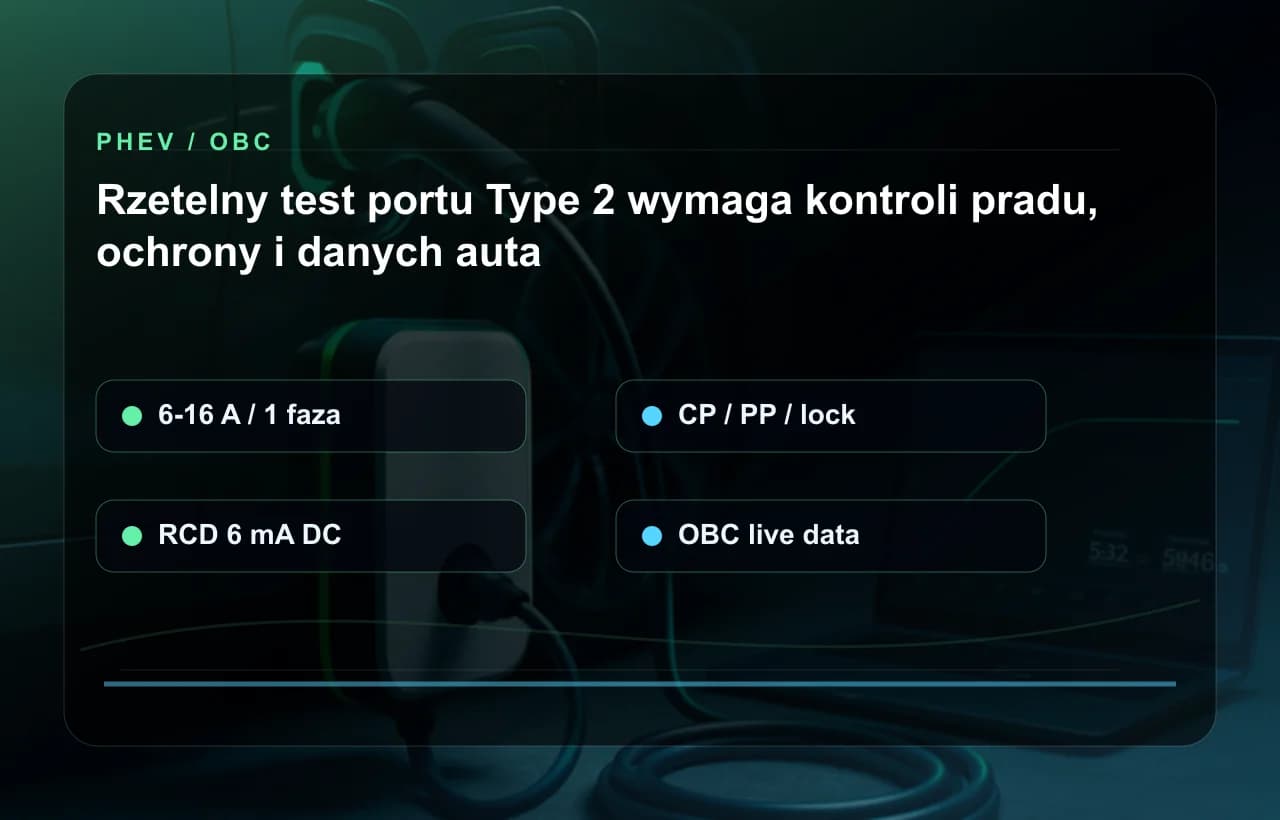
Scope of a reliable PHEV charging socket test: adjustable current, CP/PP, 6 mA DC RCD and OBC live data.
PHEV / OBC

A reliable charging port test is a controlled scenario, not a quick 'does it light up'

Only combining adjustable current, protections, and car data allows you to distinguish cheap pretense from diagnostics.

Typowa pułapka

Decyzja zakupowa

Najwięcej kosztuje to, czego nie sprawdziłeś przed umową.

EV/PHEV charging requires taking leakage seriously. In practice, Mode 2 charging equipment should have IC-CPD protective functions, and a diagnostic test should include detection of the DC component of residual current, typically 6 mA DC, alongside AC protection.

How to distinguish a damaged Type 2 socket from an OBC or installation problem?

The charging socket isn't just a plastic hole in the fender. It involves power pins, protective conductor, CP/PP lines, a temperature sensor in some designs, a mechanical lock, and communication with the onboard charger.

If the car doesn't charge, the cause could be a dirty or damaged pin, broken CP path, non-working plug lock, voltage drop in the installation, OBC error, or BMS limitation. Without a step-by-step test, each of these scenarios looks similar to a seller: 'sometimes it doesn't catch'.

That's why we check both the physical port and the car's data. If the problem goes beyond the socket itself, a natural extension is HV battery and high-voltage system diagnostics.

Test cost versus the cost of a mistake: when do you pay for diagnostics, and when for an illusion?

The difference in cost between a quick 'charging check' and a reliable test is usually small compared to the cost of a mistake. A damaged OBC, flooded port, or wiring problem can turn an attractive PHEV into a car that mainly drives like a heavier combustion version.

In a purchase decision, it's not just about whether the battery has a good SOC on inspection day. What matters is whether the car can actually accept energy from the grid and maintain electric mode in daily use. At this point, it's worth combining the socket test with a battery assessment, because the charge indicator alone doesn't tell you about the pack's condition. We described this more broadly in the guide on how SOH differs from SOC in batteries.

If the test result is stable, you have an argument for buying. If the result is ambiguous, you have an argument for negotiation or stopping the transaction before an expensive surprise.

When is it worth ordering a PHEV charging socket test instead of asking the seller for a 'cable demonstration'?

It pays off most before buying a used PHEV, after bodywork repair near the charging port, after flooding, with an import history, or when the seller can't show regular charging of the car from the grid.

It's also worth doing the test when the car has charging-related messages, sporadically interrupts a session, doesn't lock the plug, charges only with a specific cable, or shows unusual charging times.

If you need a test with adjustable current, protection, and data interpretation, choose a scope that includes charging system and HV battery diagnostics, not just confirmation that the light at the socket came on.

FAQ: cost and scope of a PHEV charging socket test

How much should a reliable PHEV charging socket test cost?+

Most often, it's a cost comparable to HV system diagnostics, not a quick cable plug-in. The price depends on travel, test time, measurement scope, report, and whether you need to distinguish between the port, installation, OBC, and BMS.

Why isn't a simple check with a 230 V outlet enough?+

Because it only shows that the car started a session. It doesn't tell you whether the Type 2 port communicates CP/PP correctly, whether the lock works under load, whether the OBC maintains a stable current, or whether the protection detects DC leakage.

Why is adjustable current needed in a PHEV charging test?+

Adjustable current lets you see the car's response to different conditions: start from low load, stabilization, limitation, session interruption, and OBC behavior. Without it, it's easy to confuse an EVSE limitation with a car fault.

What is RCD 6 mA DC in the context of charging?+

It's detection of the DC component of residual current, important for EV/PHEV charging. If the test equipment or EVSE lacks proper protection, the test may be cheap, but it's not a sensible service test.

Will such a test tell you if the entire OBC needs replacing?+

Not always immediately, but it allows you to separate scenarios: a mechanical port problem, CP/PP error, plug lock, installation limitation, OBC issue, or BMS reaction. Only after that does a repair estimate make sense.

Related services

If you want to verify this, check the service

Consult result