2026-03-31 • 9 minZakup i Weryfikacja
Green Cell Habu 11kW: 3-phase EV charging test before purchase
A test drive won't show you a charging problem. A full-load 3-phase test will.
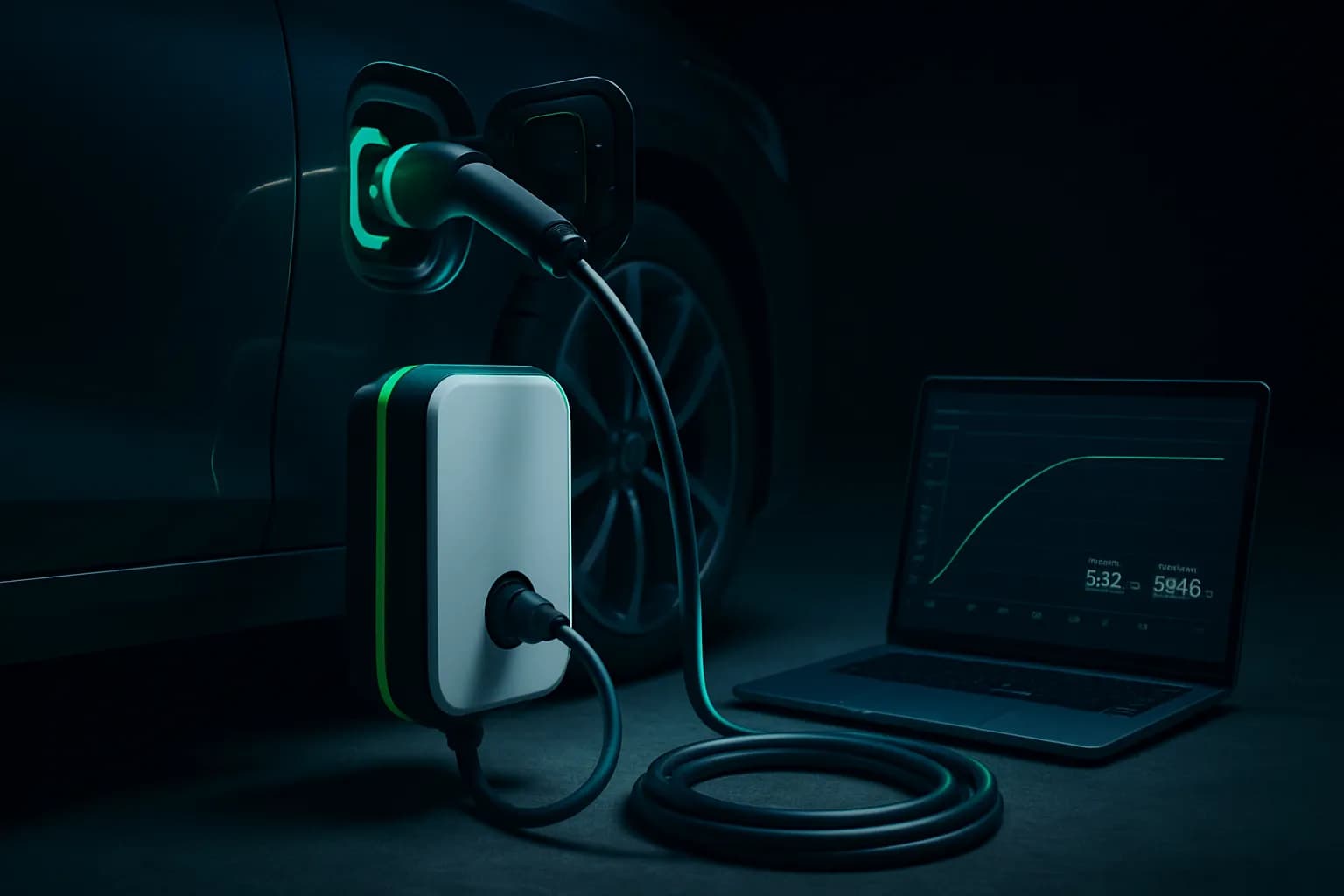

A test drive won't show you a charging problem. A full-load 3-phase test will.
During a test drive, the battery is discharging — the OBC (onboard charger) isn't working at all. Charging problems only appear after connecting to an EVSE.
A test with a 3-phase 11kW charger (Green Cell Habu) forces maximum load on the AC path. It's like a stress test for the onboard charger — if something is wrong, we'll see it on the current curve within a dozen or so minutes.
For an EV buyer, this is one of the cheapest ways to avoid spending 3000–8000 PLN on an OBC replacement after purchase.
Ogłoszenie vs rzeczywistość
Ładne ogłoszenie nie jest jeszcze dobrym autem.
A test drive won't show you a charging problem. A full-load 3-phase test will.
The most common signals: the car doesn't start a charging session, stops after a few minutes, charges on one phase instead of three, or draws significantly less current than the manufacturer declares.
Note: reduced charging current at very low or very high battery temperatures is normal BMS (Battery Management System) behavior. Similarly, the first and last 10% SOC charge slower — that's not a fault, just cell physics.
The problem starts when the car, at a temperature of 15–35°C and SOC 20–80%, doesn't reach its declared AC charging power. That's when we have a reason to test.
The OBC is an AC/DC converter installed in the car. It converts alternating current from the grid into direct current to charge the battery. In the 3-phase 11kW version, it consists of three independent rectifier paths.
Degradation of one path (e.g., a damaged MOSFET transistor, a burnt capacitor, connector corrosion after flooding) causes a power drop of 1/3 or a complete loss of one phase. In a single-phase 2.3kW test, this defect may be invisible — the car "charges", but at a fraction of the power.
That's why a test with an 11kW charger is crucial: it forces simultaneous operation of all three AC paths and reveals current asymmetry, thermal instabilities, and communication errors that remain hidden under low load.
AVILOO to austriacki system certyfikacji baterii EV — test trwa ok. 20 min jazdy i generuje europejski certyfikat SOH akceptowany przez dealerów i ubezpieczycieli.
Read more→Toyota Prius II z 2004 r. potrafiła przejechać ponad 500 000 km na oryginalnej baterii NiMH — ale taksówki w gorącym klimacie tracą baterię już po 150 000 km przez przegrzewanie.
Read more→We connect the Green Cell Habu 11kW to a power outlet (CEE 16A, 3-phase) and initiate a vehicle charging session. Simultaneously, we monitor the current on each phase with Pico TA018 clamps, the 12V battery voltage, and data from computer diagnostics (Autel Ultra S2).
In the first 5–10 minutes, we observe: whether the car negotiates full 11kW power, whether the current on the three phases is symmetrical (a difference of ~0.5A is normal, above 2A is a warning signal), and whether any session interruptions occur.
After 15–20 minutes of stable charging, we check the thermal curve — whether the OBC and battery maintain temperature within the operating range, and whether the BMS starts limiting current without reason.
We compare everything with diagnostic data: live data from the charging module, CP/PP statuses, and any DTC codes related to the OBC and Type 2 port communication.
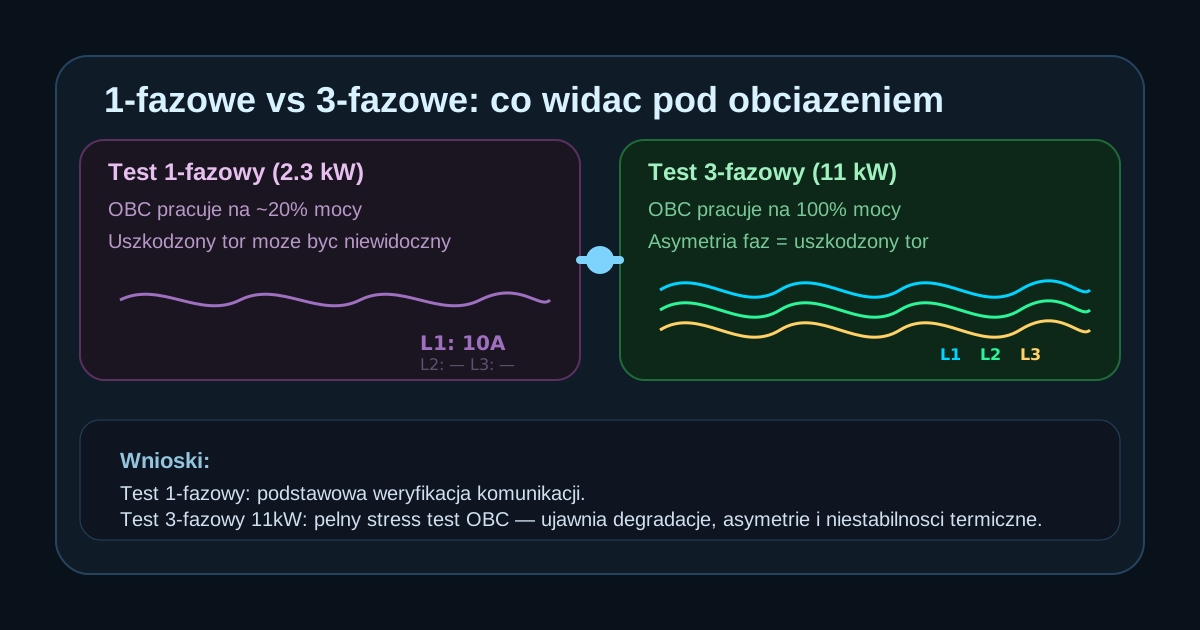
Single-phase vs three-phase: what's only visible under full load
At 2.3kW, the OBC works at a fraction of its power. Only 11kW forces full opening of all AC paths and reveals instabilities.
Decyzja zakupowa
Najwięcej kosztuje to, czego nie sprawdziłeś przed umową.
We connect the Green Cell Habu 11kW to a power outlet (CEE 16A, 3-phase) and initiate a vehicle charging session. Simultaneously, we monitor the current on each phase with Pico TA018 clamps, the 12V battery voltage, and data from computer diagnostics (Autel Ultra S2).
A healthy OBC at SOC 20–80% and temperature 15–35°C should maintain power close to the declared value (e.g., 11kW ±10%) throughout the test. Current on the three phases should be symmetrical with a deviation of up to ~0.5A.
Warning signals: power drops below 70% of declared without thermal reason, current on one phase is zero or significantly lower, the session interrupts and resumes cyclically, the car "renegotiates" power every few minutes.
Trap: a seller may claim the car "has an 11kW OBC", but in reality, a specific market version has a 7.4kW OBC (e.g., some Hyundai Kona, basic VW ID.3 trims). We check this in the VIN specification, not on word.
If a single-phase test from a 230V outlet looked "fine", but a three-phase test reveals problems — that's exactly why we do a full-load test. The analogy from the article about PHEV charging test applies doubly here: a single-phase test is not enough.
Stable result (power ±10% of declared, phase symmetry, no interruptions) — this is a strong argument for purchase. The OBC is functional, and the cost of potential charging problems is eliminated.
Result with deviations (power 70–90%, slight asymmetry, occasional fluctuations) — negotiate the price. The car drives and charges, but the OBC shows early signs of degradation. OBC replacement costs 3000–8000 PLN depending on the brand.
Bad result (one phase missing, session interruptions, power below 60%) — walk away or commission deep diagnostics. A full HV battery and inverter diagnostics will show whether the problem is limited to the OBC or goes deeper — to the BMS, contactors, or the traction battery itself.
The charging test is one element of a full EV/PHEV audit. If you're interested in a broader picture of the car's condition, also check the difference between battery SOH and SOC — because "100% charge" doesn't mean a healthy battery.
The NRGkick article describes a single-phase PHEV test and focuses on recuperation. This post is an extension to full 3-phase load, which makes sense primarily for BEVs with 11kW+ OBC.
Frequently asked questions about 3-phase EV charging (FAQ)
Yes, provided the car has a Type 2 socket and supports AC charging (so practically every EV and PHEV sold in Europe). The maximum power depends on the vehicle's OBC — if the car has a 7.4kW OBC, it won't draw more than 7.4kW, even from an 11kW charger.
A single-phase test (up to 3.7kW) checks basic communication and the minimal charging path. A three-phase test (up to 11kW) loads the OBC at full AC power, revealing thermal issues, current instabilities, and component degradation that may not show up under low load.
Technically yes, but the result is limited. A 230V outlet is only 2.3kW — too little to load the OBC and see how it handles full current. It's like testing an engine at idle and claiming it's healthy.
This is a common and costly problem. It can mean a damaged OBC module, a CP/PP communication error, a building installation issue, or a deliberate factory limitation (some versions have a 1-phase OBC). Without a three-phase test, you can't tell a hardware limitation from a fault.
No. The bottleneck can be in: the building's electrical installation (voltage drops, undersized wires), the charging cable (damaged CP/PP pins), the battery's thermal limitation (BMS reduces current at high temperature), or the car's settings (current limit in the menu). The Green Cell Habu 11kW test allows us to systematically eliminate causes.
Precyzyjny odczyt SOH, test inwerterów i rozwiązywanie problemów z zasięgiem.
Test baterii, izolacji i lakieru. Nie kupuj hybrydy w ciemno.