
Hybspec
2026-03-0210 minBłędy, Objawy i AwarieSeries: Błędy i Awarie

HV Insulation Faults in Post-Crash Cars. When Does the Car Cut Off High Voltage?

Importing a slightly damaged car from the USA is a dream for many drivers looking for a cheap hybrid or electric vehicle (EV). "Only bumper and lamp damaged, airbags intact" — the ad says. You decide to buy, the car goes to the body shop, parts are replaced, the paint shines. You get in, press START, and on the dashboard appears the message "Check Hybrid System" or "Isolation Fault". The high-voltage safety systems have just cut off power from the traction battery.
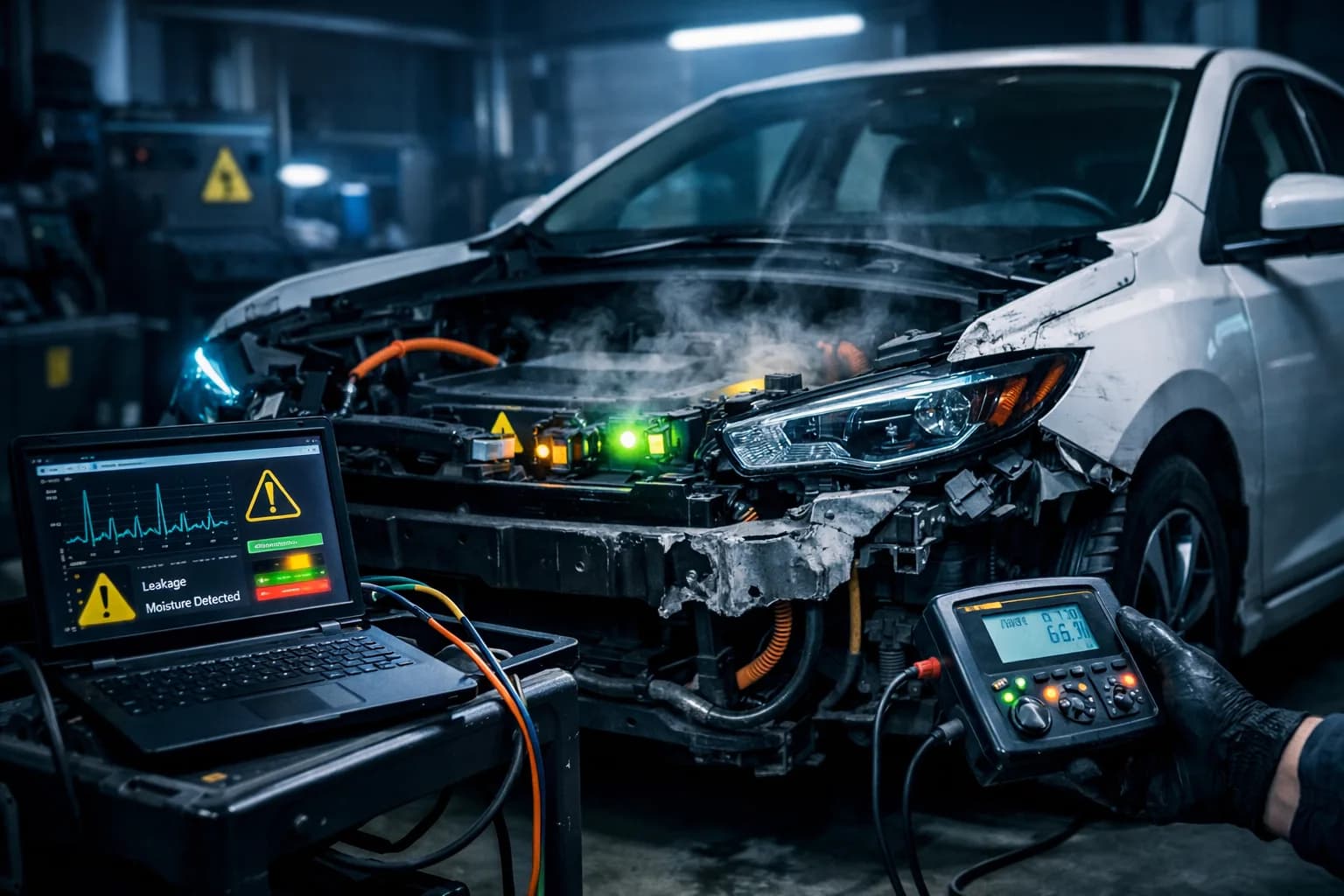
Auto po stłuczce z USA podczas analizy błędów izolacji HV.

In Brief: After a crash and import from the USA, insulation can "give way" due to moisture — the car cuts off HV to protect people

An Isolation Fault is not an "electronic whim." It's a signal that current from the HV system may be leaking to the body — so the car preemptively cuts off high-voltage power.

After import from the USA, a common trigger is moisture and sea salt, which penetrates micro-cracks in the insulation and closes the leakage circuit.

Don't start by clearing fault codes. Start by measuring insulation resistance and locating the circuit that is lowering the result.

Zapamiętaj

Bezpieczeństwo pomiaru

W układach HV spokojny pomiar jest cenniejszy niż szybka pewność.

Importing a slightly damaged car from the USA is a dream for many drivers looking for a cheap hybrid or electric vehicle (EV). "Only bumper and lamp damaged, airbags intact" — the ad says.

Floating Ground and the Physics of a Crash. Why Does the Car Panic?

In a traditional combustion engine car, the body serves as the negative terminal for the 12V battery. In electrified vehicles (HEV/PHEV/EV), the situation is different. Current at voltages from 300V to 800V, flowing in orange cables, is completely isolated from the car's metal body (so-called Floating Ground).

The battery management system (BMS) monitors the electrical resistance between the HV network and the body hundreds of times per second. During a collision, even a slight displacement of components under the hood can damage a cable's insulation. The system instantly detects a drop in resistance and opens the main contactors in the battery to protect passengers and rescuers from DC electric shock.

What the Body Shop Doesn't See? Clearing Faults Is Not Enough

Traditional body shops are experts at repairing body panels, but high-voltage electronics require a separate measurement procedure. Simply trying to clear the crash data with a cheap OBD2 scanner does not solve the physical insulation breakdown.

If the leakage still exists, the fault will return immediately. If it's microscopic, the car may start dry but will shut off, for example, during rain. Therefore, the only safe path is laboratory-grade insulation resistance measurements with a megohmmeter.

Did you know...Batteries

Baterie LFP (np. BYD Blade Battery) powinny być ładowane do 100% co najmniej raz w tygodniu — to pozwala BMS prawidłowo zbalansować napięcia w celach.

Read more
Did you know...Makes & Platforms

Chińskie EV (BYD, MG) mają "Security Gateway" blokujący dostęp diagnostyczny standardowymi narzędziami OBD2 — potrzebne są dedykowane biblioteki i autoryzacje.

Read more

Underbody Impact – The Silent Killer of EVs

In full EVs, batteries are often located in the vehicle floor. Hitting a high curb, rock, or tire can deform the pack's shield and lead to a local short circuit or insulation drop.

Even without a cracked housing, internal deformation can press cells against the frame and trigger an insulation fault. In such cases, deep verification of high-voltage modules and traction battery cells is necessary.

Typowa pułapka

Typowy błąd

Tu większym problemem niż błąd bywa zbyt lekka ręka do tematu.

In full EVs, batteries are often located in the vehicle floor. Hitting a high curb, rock, or tire can deform the pack's shield and lead to a local short circuit or insulation drop.

How to Interpret the Insulation Result (MΩ) and Why It "Sometimes Works, Sometimes Doesn't"

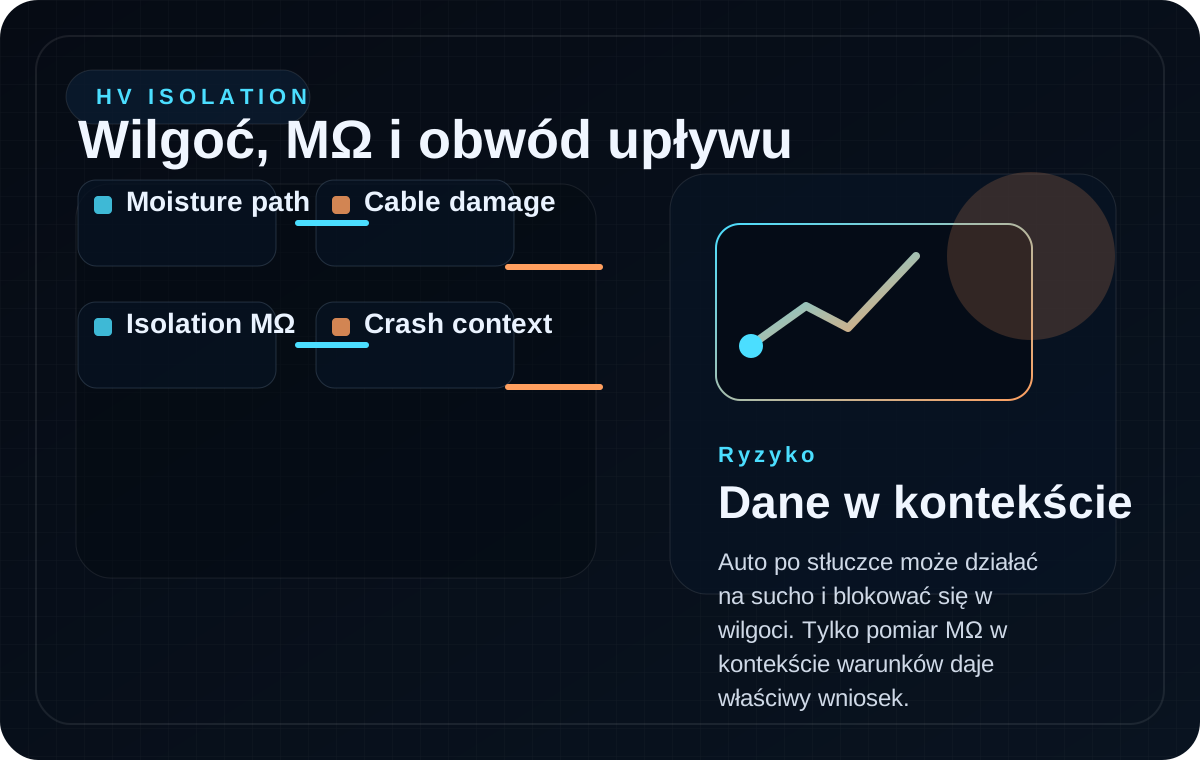
HV insulation fault diagram after importing a car from the USA, accounting for moisture and cable damage.
MΩ Diagram

Why the "Weather-Dependent" Insulation Fault Returns

The MΩ result must be read with a trend and moisture context. Only then can you distinguish a temporary symptom from a real, progressive leakage.

An insulation fault is often "conditional": it appears after rain, after a car wash, or after a long stop in humidity. On dry days, the car may start and drive "normally." This is a classic picture of micro-cracks in insulation or moisture in HV connectors.

The insulation result is given in megohms (MΩ). From a safety perspective, we're not just interested in "is there a fault," but how far the result is from the threshold and whether it shows a worsening trend over time.

If you want to understand the thresholds and measurement logic, see: interpretation of the 1000V insulation test result.

Decision: What to Do After Import/Collision to Safely Return to Repair and Driving

If the insulation is too low — the priority is to locate the circuit with leakage and remove the cause (cable, connector, component). Only then does a reset and adaptations make sense.

If the insulation is correct but the car still won't start — then we move to logs, crash data, and control units, because the lockout is no longer due to physics, but from the control layer.

The most "solid" first step is measurement: HV insulation measurement with a 1000V megohmmeter.

Insulation Loss in Post-Accident Cars (FAQ)

Does an Isolation Fault after an accident always mean the main battery is destroyed?+

Definitely not. The battery itself is usually placed in the safest zone of the car and rarely loses its seal in light to moderate collisions. Very often, the culprits are chafed orange cables running from the front of the vehicle to the A/C compressor, a crushed inverter, or a cracked housing of the electric PTC heater.

Why did the post-accident car work at the auction yard in the USA, but after arriving in Europe it has an insulation fault?+

The main culprit is moisture and sea salt. Micro-cracks in the insulation of cables, connectors, or the inverter housing may not conduct electricity in a dry climate (e.g., California or Texas). However, several weeks spent on a ship in humid, heavily salted ocean air allow water to penetrate the micro-cracks. An electrical bridge forms between the HV cables and the body, which immediately triggers an insulation fault when the car rolls off the trailer in Poland.

A mechanic says he can fool the insulation sensor with a resistor so the car can drive again. Is that safe?+

This is an extremely dangerous and illegal practice, risking vehicle fire or fatal electric shock. The insulation fault sensor is the most important protection system in EVs (it works similarly to a residual-current circuit breaker in your home). Deliberately bypassing this safety feature (so-called resistance spoofing) means that in the event of a fault or during rain, a voltage of several hundred volts could appear on your car's body, endangering you, your children, and emergency services.

Related services

If you want to verify this, check the service

Consult result