Hybspec
2026-03-1010 minLive Data i DiagnostykaSeries: Volkswagen / Live Data

Live Data VW: EPC Warning Light, 1.5 TSI Kangaroo and DSG Under Load

Volkswagen often gives the driver a simple message, but the problem underneath is multi-layered. EPC, 1.5 TSI jerking and DSG symptoms need to be viewed in logs from the exact same driving scenario in which the car starts behaving illogically.

Volkswagen engine bay with a technician examining EPC and DSG live data on a diagnostic tablet.

In Short: In a Volkswagen, EPC, Kangaroo and DSG Must Be Read Together, Not Separately

If the car shows EPC, jerks under light throttle or the transmission behaves nervously when pulling away, you must immediately assume the problem may involve several layers simultaneously: engine, torque control and transmission.

That is why one fault code is not enough in diagnostics. Road logs and data comparison at the moment the symptom actually occurs are key.

To organize your method of working with parameters, also read: live data and freeze frame methodology.

Zapamiętaj

Komunikat vs dane

Komunikat to dopiero początek. Dane dopiero zaczynają rozmowę.

Volkswagen often gives the driver a simple message, but the problem underneath is multi-layered. EPC, 1.5 TSI jerking and DSG symptoms need to be viewed in logs from the exact same driving scenario in which the car starts behaving illogically.

VW EPC Warning Light Loss of Power: Which Data Will Tell You the Most?

The phrase 'VW EPC warning light loss of power' is very specific from the user's perspective, but still technically broad. In the data, key points are: accelerator pedal position vs actual throttle opening (discrepancy >5% = signal problem), requested vs actual boost (target ~1.35 bar at WOT on 1.5 TSI DADA — if actual <0.9 bar, we have underboost), LTFT (norm ±5%, alarm >±15%) and the torque calculated by the ECU.

If the ECU requests e.g. 180 Nm, but the actual torque drops to 90 Nm while ignition angle is pulled back to 0° or negative values, we have active knock protection — and that is exactly why the car cuts power protectively.

VW 1.5 TSI Kangaroo: What to Look for in Data Under Light Acceleration?

Queries around '1.5 TSI kangaroo' clearly show this is not a problem that can be fairly assessed at idle. You need to reproduce light load (1200–1800 rpm, 20–40% throttle opening) and watch: Boost Pressure Actual vs Specified (difference >0.15 bar = anomaly), Ignition Angle (drop >5° from base = knock protection), Throttle Valve Angle vs Accelerator Position (delay >200 ms = by-wire problem).

In the 1.5 TSI DADA/DPCA, a typical kangaroo scenario is torque fluctuation of ±15–25 Nm at a constant pedal position, visible as oscillation in the Torque Actual vs Torque Specified log. Without recording this scenario, you can condemn a part that merely reacts to the primary anomaly.

Did you know...High Voltage

Układ HV w EV/HEV używa "masy pływającej" — obwód wysokiego napięcia jest całkowicie odizolowany od karoserii. Gdy izolacja spadnie poniżej 100 Ω/V, BMS natychmiast odcina zasilanie.

Read more
Did you know...Diagnostics

AVILOO to austriacki system certyfikacji baterii EV — test trwa ok. 20 min jazdy i generuje europejski certyfikat SOH akceptowany przez dealerów i ubezpieczycieli.

Read more

VW DSG Jerks: When Is It Really the Transmission, and When Does the Problem Start in the Engine?

DSG jerking when pulling away does not always mean a mechanical transmission fault. In the DQ200 (dry dual-clutch), normal oil temperature is 80–110°C; above 130°C the ECU starts limiting torque. Clutch K1/K2 slip is normally <3% — if it rises >5%, that is a real sign of wear.

But if at the same time the engine input torque oscillates ±20 Nm (visible in Engine Torque Actual), the transmission is only revealing the symptom. That is why you need to compare temperatures, slip, learned values and engine data at the same moment — before someone spends 4,000–6,000 PLN on a mechatronics unit.

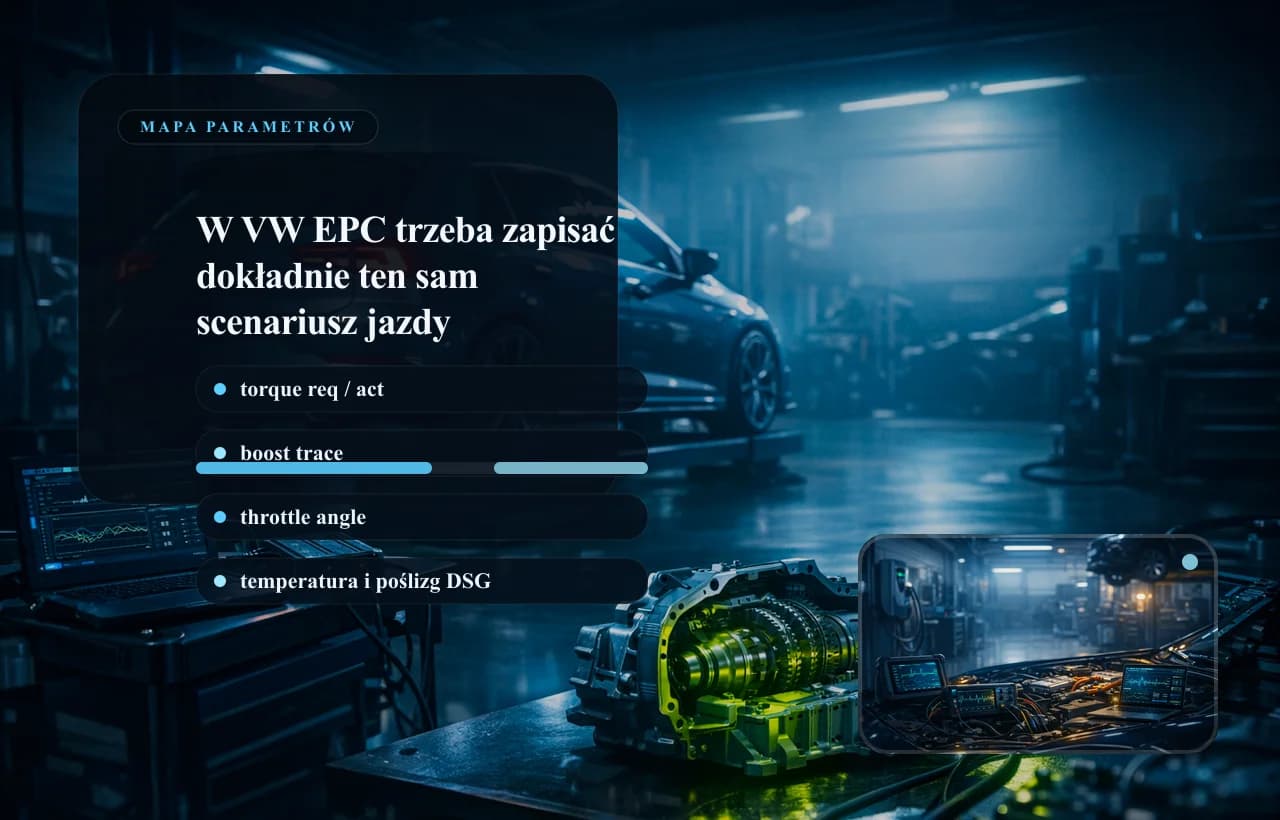
VW live data panel: EPC, requested torque, boost and DSG temperature.
VW Live Data

EPC and Kangaroo Must Be Caught in the Same Driving Scenario

Only a parallel recording of torque, throttle, boost and transmission parameters shows where the symptom originates.

Typowa pułapka

Koszt błędnej interpretacji

Najdroższa interpretacja zwykle pojawia się za wcześnie.

DSG jerking when pulling away does not always mean a mechanical transmission fault. In the DQ200 (dry dual-clutch), normal oil temperature is 80–110°C; above 130°C the ECU starts limiting torque.

How to Distinguish a Need for Adaptation from a Real Fault in a VW?

Adaptation makes sense when the system can execute the command and there is no active mechanical or electrical problem. If values do not reach the expected level, a reset usually only masks the issue temporarily.

That is why you read data first, and only then decide on service procedures.

Decision: When a Road Log Is Enough, and When a VW Requires Full Diagnostics

If the symptom returns regularly and the car loses power or jerks more and more clearly, it is not worth relying on random fault clearing. The most sense then is diagnostics based on live data, freeze frame and active tests.

The right service direction is VW diagnostics on road logs, 1.5 TSI and DSG. If the problem also touches the platform, Gateway or basic settings, there is also the VAG section with common procedures.

FAQ: Live Data VW, EPC, 1.5 TSI and DSG

Does the EPC warning light in a VW always mean a throttle or accelerator pedal fault?+

No. EPC is a message related to electronic powertrain control. It can result from an ignition, boost, throttle, sensor or torque limitation logic issue.

What does 1.5 TSI kangaroo mean in practice?+

It most often refers to jerking during light acceleration and partial load. To narrow down the cause, you need to reproduce the symptom in a road log and observe torque, throttle, ignition and boost.

Does DSG jerking in a VW always start with the transmission?+

No. When pulling away and downshifting, the transmission works on input data from the engine. If torque is unstable, the symptom can be misleadingly similar to a DSG fault.

Can EPC be fairly assessed without a test drive?+

Rarely. If the symptom is load- or temperature-dependent, a static reading from a standstill usually does not show the full picture.

Which service does this type of problem fit?+

Most often, it fits separate VW diagnostics with dynamic logs, and the VAG hub if the topic also involves basic settings, Gateway or common platform procedures.

Related services

If you want to verify this, check the service

Consult result