Hybspec
2026-03-1010 minLive Data i DiagnostykaSeries: Hyundai / Live Data

Live Data Hyundai: Ioniq, Tucson and Check Hybrid System Without Guessing

In a Hyundai, the check hybrid system message often looks like one problem to the driver, but in the data it can mean several very different scenarios. To distinguish 12V supply, HV pack, cooling and combustion part, you need to see what happens before the message, not just after it.

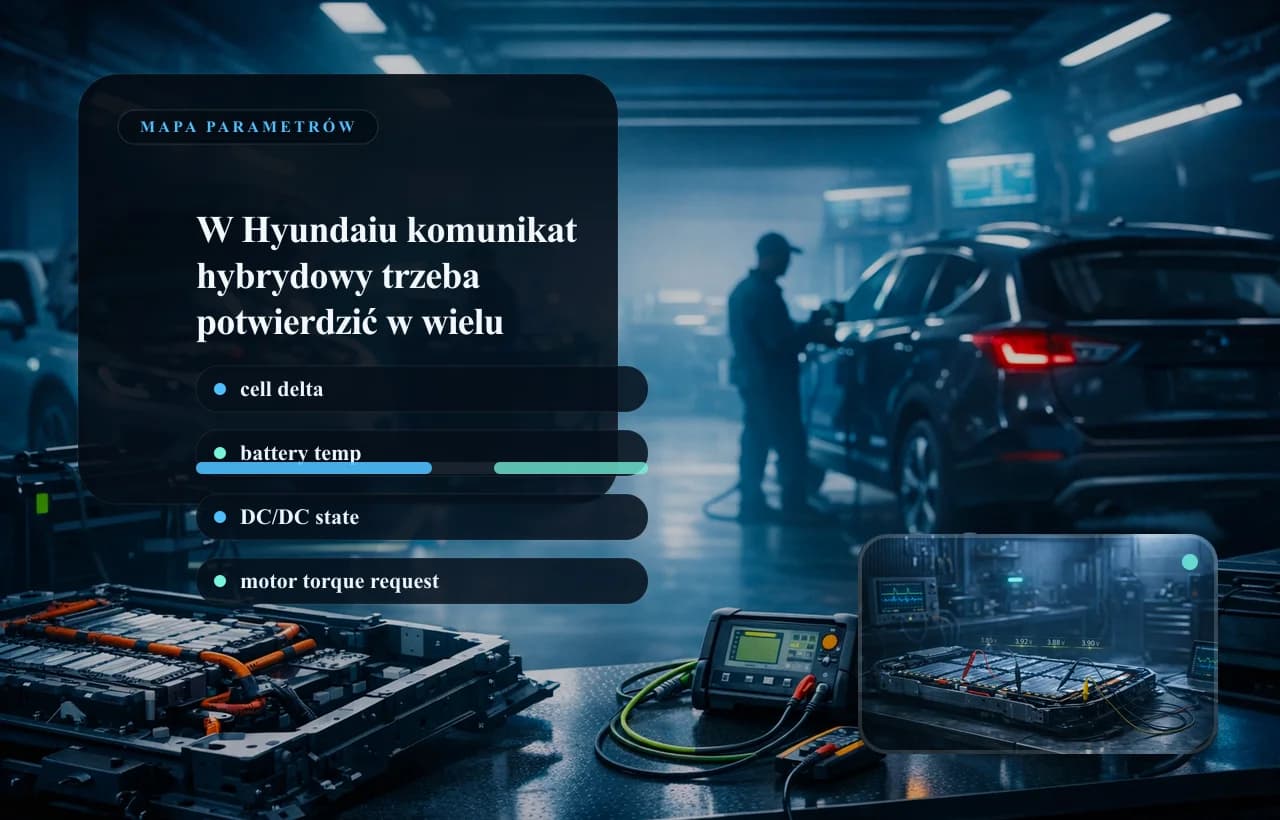
Hyundai Ioniq or Tucson hybrid with a diagnostic tablet showing check hybrid system live parameters.

In short: in a Hyundai check hybrid system must be separated into 12V, HV and combustion part

If a Hyundai reports check hybrid system or loses power, the first task is to determine whether the anomaly started in the auxiliary supply, the HV layer or normal engine operation. Without this, the message is simply too broad.

The most sense here comes from simultaneous monitoring of 12V state, HV voltages and temperatures, load and engine parameters.

We describe the method of working with such logs in more detail here: methodology of reading live data logs.

Zapamiętaj

Komunikat vs dane

Komunikat to dopiero początek. Dane dopiero zaczynają rozmowę.

In a Hyundai, the check hybrid system message often looks like one problem to the driver, but in the data it can mean several very different scenarios. To distinguish 12V supply, HV pack, cooling and combustion part, you need to see what happens before the message, not just after it.

Hyundai check hybrid system: what does this message really mean?

Phrases like 'Hyundai check hybrid system', 'stop safely' and 'turn off engine' clearly show that the user receives a final message but does not know which system layer failed. Key parameters to check: Auxiliary Battery Voltage (AGM 12V: normal >12.6 V, alarm <12.0 V — in a Hyundai, weak 12V can trigger a cascade of HV alerts), HV Battery SOC (Ioniq HEV: 1.56 kWh Li-polymer pack, normal operating range 20–80%), Cell Voltage Delta (normal <50 mV between cells, >100 mV = module degradation), Battery Coolant Temperature (normal <40°C, alarm >50°C).

Only the activation conditions and sequence of deviations in the data allow separating the HV problem from the rest of the system. Replacing a 12V AGM battery in an Ioniq costs ~500–800 PLN, replacing an HV module costs 8,000–15,000 PLN — so the diagnostic sequence matters.

Hyundai check hybrid system stop safely / turn off engine: which data is a priority?

With such a warning, the key is whether 12V, temperature, HV voltages or engine controller operating conditions dropped first. Only then do you know whether the message was a consequence of a hybrid problem or secondary protection of the entire car.

This is also one of those scenarios where a static reading from a standstill is usually insufficient without comparison with a road log.

Did you know...High Voltage

Układ HV w EV/HEV używa "masy pływającej" — obwód wysokiego napięcia jest całkowicie odizolowany od karoserii. Gdy izolacja spadnie poniżej 100 Ω/V, BMS natychmiast odcina zasilanie.

Read more
Did you know...Batteries

SOC (State of Charge) to ile energii jest teraz w baterii. SOH (State of Health) to ile bateria jest w stanie zmagazynować w porównaniu do fabrycznej pojemności. Dashboard najczęściej pokazuje SOC, nie SOH.

Read more

Hyundai Ioniq check hybrid system: what do the data most often show before failure?

Hyundai live data panel: HV battery, cell deviations, drive temperature and DC/DC converter.
Hyundai Live Data

The message must be separated into system layers

Only combining 12V, HV and combustion part data shows whether the problem is in the hybrid or outside it.

In the Ioniq (Li-polymer pack 1.56 kWh / 240 V), correlation tells a lot: Battery Module Temp 1-4 (difference >8°C between modules = cooling problem or local degradation), Cell Voltage Min vs Max (spread >80 mV under load = weakening module), Battery Fan Speed (if 0 rpm at temp >42°C = blocked duct or damaged fan). These moments most often show the first irregularities earlier than the dashboard description itself.

It's worth knowing that in Hyundai hybrids and plug-ins, a known cause of 12V supply problems is a damaged ICCU (Integrated Charging Control Unit). If replacing the 12V battery does not solve the problem and the car still loses voltage after parking, the ICCU should be one of the first suspicions.

Typical HV diagnostics cost 590–890 PLN, while replacing a battery module without diagnostics costs 8,000–15,000 PLN. Distinguishing a long-term problem from a single incident (e.g., overheating after a long highway drive) determines repair costs.


Typowa pułapka

Koszt błędnej interpretacji

Najdroższa interpretacja zwykle pojawia się za wcześnie.

In the Ioniq (Li-polymer pack 1.56 kWh / 240 V), correlation tells a lot: Battery Module Temp 1-4 (difference >8°C between modules = cooling problem or local degradation), Cell Voltage Min vs Max (spread >80 mV under load = weakening module), Battery Fan Speed (if 0 rpm at temp >42°C = blocked duct or damaged fan). These moments most often show the first irregularities earlier than the dashboard description itself.

Hyundai Tucson hybrid check hybrid system: how to distinguish 12V, HV and additional warnings?

Auto-suggestions for the Tucson show that alongside check hybrid system, additional alerts like stop safely or check brake system also appear. This is a signal that you need to read relationships between controllers, not a single message in isolation.

Only by combining data from the supply, HV and safety modules does it become clear whether we are dealing with a primary fault or a cascade of protective limitations.

Hyundai Tucson lack of power: when does the problem not start in the hybrid?

Phrases about lack of power in the Tucson show that users often mix two diagnostic directions: hybrid and purely engine-related. Without data, it's not known whether the problem is in the HV layer or in the air, fuel and turbocharging of the combustion part.

That's exactly why you need to compare load, boost, mixture and torque limitation parameters with the hybrid system's behavior.

Decision: when is monitoring enough, and when does a Hyundai require full HV and drivetrain diagnostics?

If the message returns, the car loses dynamics or switches illogically between drive modes, relying on a simple reset is not worthwhile. Full diagnostics of data from the hybrid and drivetrain system makes the most sense then.

In such a scenario, the proper direction is full analysis of the HV pack and hybrid layer and, if needed, analysis of the combustion part.

FAQ: Live Data Hyundai and Check Hybrid System

Does check hybrid system in a Hyundai always mean a battery problem?+

No. The message can result from 12V, HV layer, cooling, drive control, a damaged ICCU (Integrated Charging Control Unit) or a problem in the combustion part that triggered system protection.

Why can an Ioniq show check hybrid system without one obvious mechanical fault?+

Because some problems only appear under a specific load scenario, temperature or drive transition. Live data shows this earlier than the dashboard description alone.

Are Tucson hybrid check hybrid system and Tucson lack of power the same problem?+

Not always. The symptom can start in the hybrid layer or in the engine part. Both directions must be separated based on data.

Which data is most important for check hybrid system in a Hyundai?+

12V state, HV voltages and temperatures, message activation conditions, system behavior under load and correlation with engine parameters.

Do such symptoms make sense in a pre-purchase inspection?+

Yes. A history of hybrid messages and illogical drive behavior is one of the more important warning signs for a used car.

Related services

If you want to verify this, check the service

Consult result