Hybspec
2026-03-259 minLive Data i DiagnostykaSeries: Diagnostyka / Procedury po naprawie

When after module replacement is an online procedure or coding needed, and when the problem starts much earlier

This is one of the most commonly misunderstood moments after a repair. The car still doesn't see the new module, so the immediate cry is 'the controller needs programming.' Sometimes yes, but very often the problem starts earlier: from a wrong part number, lack of power, a communication error, component protection, or unmet logical conditions. Therefore, the online procedure and coding should be the end of a well-structured process, not the first shot.
Diagnostics after module replacement and qualification for OEM online procedures.

In short: after module replacement, first confirm communication and compatibility, only then think about an online procedure

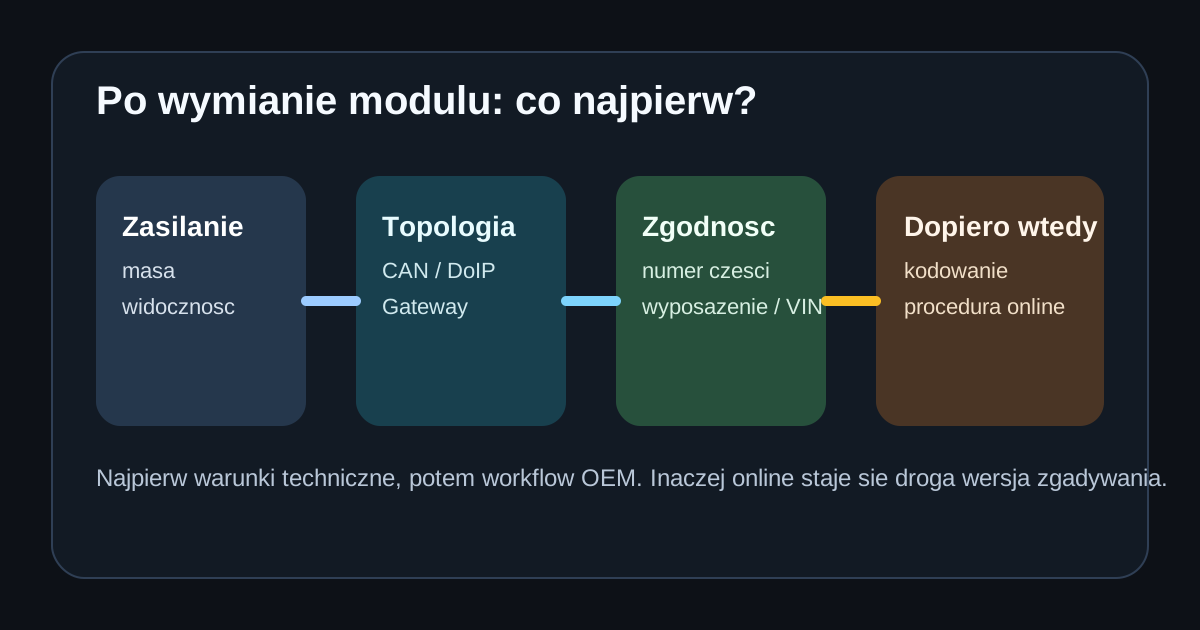
This is the most important sequence. If the module has no power, is not visible in the topology, or the part number does not match the car's configuration, no online procedure will fix the fundamental problem.

That's why we start such cases with ECU topology, communication, and power supply diagnostics, not with a promise that 'we'll program something right away.'

Zapamiętaj

Objaw vs przyczyna

Pierwszy winny z listy błędów rzadko bywa tym właściwym.

This is one of the most commonly misunderstood moments after a repair. The car still doesn't see the new module, so the immediate cry is 'the controller needs programming.' Sometimes yes, but very often the problem starts earlier: from a wrong part number, lack of power, a communication error, component protection, or unmet logical conditions.

Power supply, ground, topology, part number: what needs to be checked before the word coding is uttered?

First, we check if the new module is electrically and logically alive at all. Whether it responds on the bus, whether it appears in the Gateway or topology, whether there is a conflict with the part number, equipment, generation, or software variant.

In VAG, an important element is Component Protection, i.e., pairing modules by MAC address. Without access to ODIS or an online session, a replacement module (e.g., steering column, instrument cluster, key) simply will not work. This protection requires an active session with the manufacturer's server and VIN confirmation. Conversely, after replacing a throttle body, EGR valve, or swirl flaps, Basic Settings and channel adaptation are necessary. Adaptation values are stored in the controller's RAM, not in the module's flash itself, so their absence after replacement means incorrect system operation until recalibration.

Only when this is correct can you sensibly assess whether adaptation, assignment, component protection, or a full OEM online procedure is needed.

When does a case realistically qualify for an online procedure or OEM workflow?

When the module is compatible, the network and power supply are correct, and the manufacturer provides for online pairing, parametrization, immobilizer-related sync, or component protection. Without these conditions, online is not a solution, just a path to another dead end.

In the case of VAG, the online procedure (SVM/SCB) requires a stable connection to the server, and the entire process is tied to the VIN. A typical duration is 5-15 minutes per module, but with full parametrization of the charging system, it can be 30-60 minutes, and in complex cases even 1-2 hours. Parametrization includes calibration data specific to the module, e.g., injector IMA codes (correction ±2 mg per cylinder) or the steering angle sensor (zero setting ±0.5°). Offline coding typically takes 15-30 minutes, and a full online session with parametrization and verification realistically takes 30-60 minutes of diagnostic work.

For VAG platforms, this topic particularly often touches on Gateway, component protection, and VAG platform procedures.

Decision diagram after module replacement: communication, compatibility, online procedure.
VCMI2

Coding only makes sense after confirming the module is electrically and logically ready

If you skip topology, power supply, and compatibility, the online procedure becomes a very expensive version of guessing.

Did you know...Batteries

Baterie LFP (np. BYD Blade Battery) powinny być ładowane do 100% co najmniej raz w tygodniu — to pozwala BMS prawidłowo zbalansować napięcia w celach.

Read more
Did you know...Batteries

SOC (State of Charge) to ile energii jest teraz w baterii. SOH (State of Health) to ile bateria jest w stanie zmagazynować w porównaniu do fabrycznej pojemności. Dashboard najczęściej pokazuje SOC, nie SOH.

Read more

Why you shouldn't confuse qualification for a procedure with a broad claim about flashing controllers?

Because it's not an honest description of the service. The scope depends on the brand, OEM account, online access, controller type, and the specific repair case. Publicly promising 'flashing everything' suggests a reach that cannot be reliably guaranteed.

It's much more honest to say: we check the case, confirm the conditions, and qualify it for the procedure if the manufacturer and the car's architecture actually allow it.

Typowa pułapka

Typowa pułapka

Jeśli diagnoza jest szybsza niż pomiar, zwykle jest też za droga.

Because it's not an honest description of the service. The scope depends on the brand, OEM account, online access, controller type, and the specific repair case.

How to know the problem lies earlier than in the coding itself?

The new module does not respond, the car doesn't see it, a cascade of `U` errors appears, the controller disappears from the topology, or power-related symptoms appear after plugging it in. These are signals that you first need to go back to the circuit and communication layer.

This is also well illustrated in the article about CAN, DoIP, and Gateway, because that's very often where the real problem after module replacement begins.

Decision: when to enter an online procedure, and when to stop at diagnosis and not burn the client's time

If the electrical, logical, and compatibility conditions are confirmed, an online procedure makes sense. If not, the more honest and cheaper move is to stop at diagnosis, fix the basics, and only then return to the topic.

That's exactly how we treat MaxiFlash and VCMI2: as procedural tools after confirming conditions, not as a marketing shortcut to 'flashing everything.'

FAQ: online procedure, coding, and module replacement

Is coding always necessary after module replacement?+

No. It depends on the module type, brand, car generation, and whether the new component requires VIN assignment, adaptation, component protection, or an OEM online procedure.

Does a lack of communication with the new module immediately mean programming is needed?+

No. First, you need to check power supply, ground, the controller network, part number compatibility, and whether the module is even visible in the vehicle's topology.

Do you widely advertise a controller flashing service?+

No. We publicly and honestly talk about qualification for post-repair procedures, codings, and adaptations. Online reprogramming depends on the specific brand, OEM access, and a confirmed workflow.

In which brands is this topic particularly common?+

Very often in VAG, BMW, and cars with extensive controller access protection, but the diagnostic principle is broadly similar: first compatibility and topology, then the decision about the procedure.

Related services

If you want to verify this, check the service

Consult result

Diagnostyka BMW: drivetrain, live data, adaptacje

Drivetrain Malfunction, adaptacje po naprawie, Live Data i diagnostyka hybryd eDrive. Mobilnie · Łódź i woj. łódzkie · ogólnopolsko po ustaleniu.