Oscilloscope in EV diagnostics: what do inverter waveforms tell us?
In modern EV drivetrains, an oscilloscope is a tool that gives you an edge. It lets you see disturbances before a fault becomes obvious.
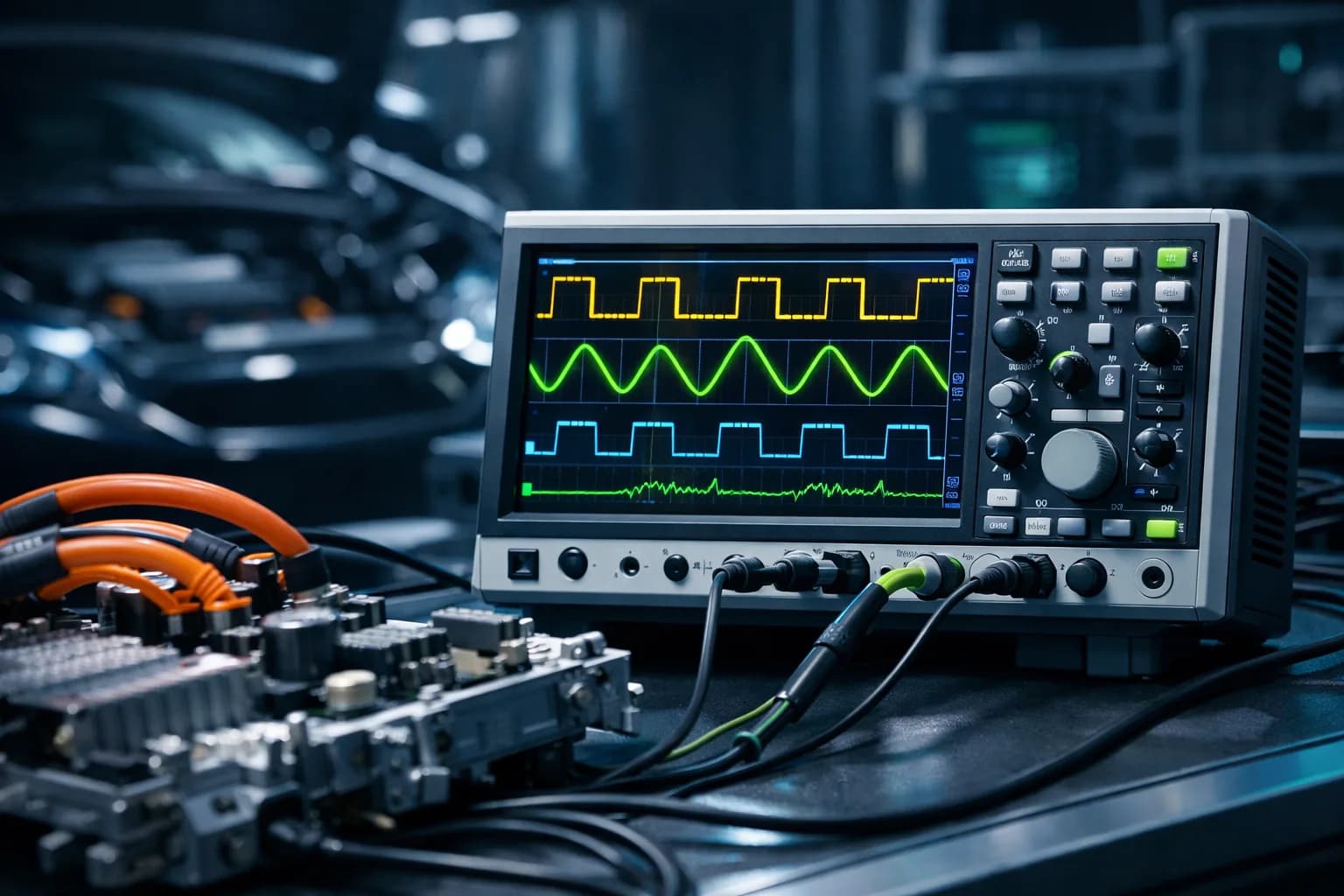

In modern EV drivetrains, an oscilloscope is a tool that gives you an edge. It lets you see disturbances before a fault becomes obvious.
Error codes (DTCs) are the 'effect' — an oscilloscope lets you see the 'cause' in real time: signal shape, disturbances, drops, and instability.
This allows you to distinguish a sensor/signal problem from an inverter power section problem and avoid replacing expensive components blindly.
If you've encountered 'clearing errors' instead of diagnosis, also see: error resetting and dealer fraud.

Quick engineer insight
Szybka wskazówka: niestabilna sinusoida zwykle wyprzedza pojawienie się twardego DTC.
Objaw vs przyczyna
Pierwszy winny z listy błędów rzadko bywa tym właściwym.
In modern EV drivetrains, an oscilloscope is a tool that gives you an edge. It lets you see disturbances before a fault becomes obvious.
DTC codes are delayed and often generic. An oscilloscope shows the signal shape in real time. The switching frequency of an HV inverter is typically 5–15 kHz — visible on the oscilloscope as a characteristic PWM pattern.
This allows separating a sensor problem from a power section problem. DC bus ripple under normal conditions is <2 V peak-to-peak at a nominal voltage of 400 V. Phase current measurement with current clamps typically gives 0–200 A RMS per phase. The isolation monitoring pulse is 10–50 V AC superimposed on the HV DC circuit.
In EV/HEV, milliseconds matter: a momentary disturbance may not yet generate a DTC, but can already degrade drive quality, range, or HV system safety. For inverter analysis, an oscilloscope bandwidth of at least 20 MHz is required (e.g., PicoScope 4425A).
Irregular phase waveforms, voltage spikes, and current disturbances under load.
Such symptoms may indicate inverter degradation, but sometimes result from installation issues.
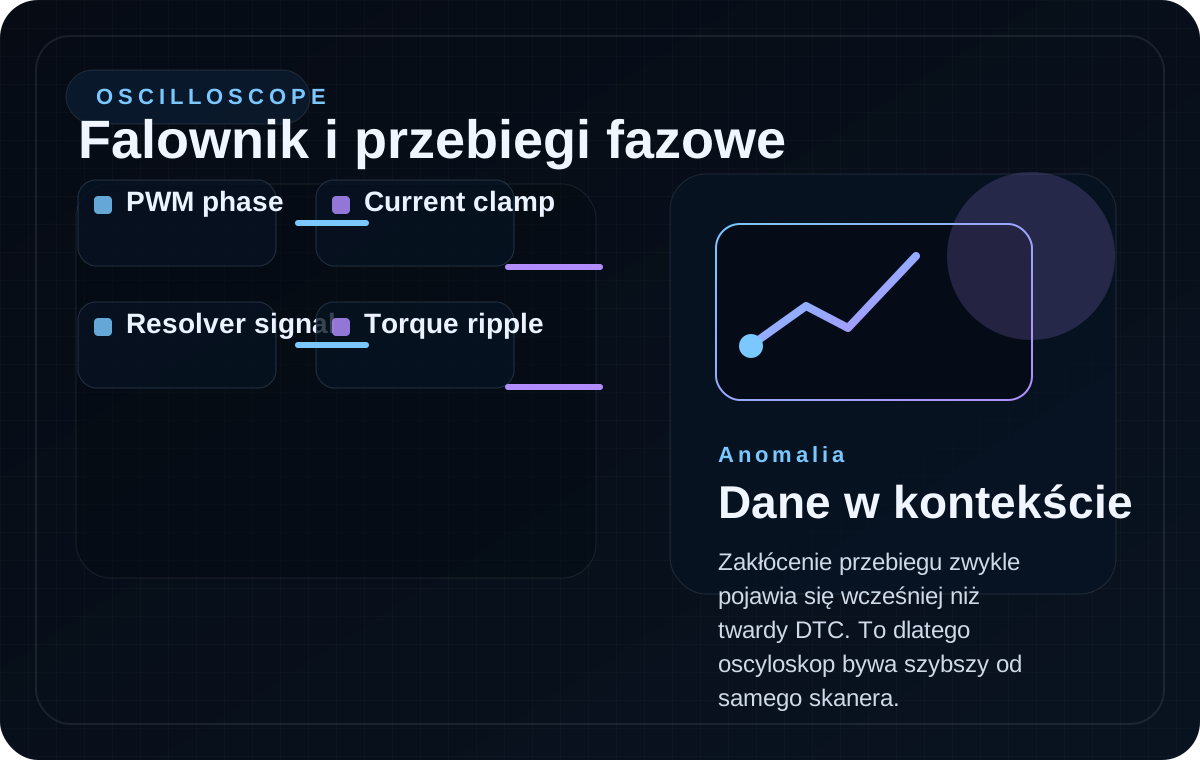
Waveform anomalies before a DTC appears
It is the analysis of the phase signal and its stability that allows distinguishing a power section problem from a sensor error.
Oscyloskop potrafi wykryć uszkodzenie pojedynczego tranzystora IGBT w falowniku EV jeszcze zanim sterownik zarejestruje jakikolwiek kod błędu.
Read more→First, we gather context: symptoms, conditions, error history, and vehicle behavior under load.
Next, we correlate live data with signal measurement (current/voltage) — this allows assessing whether the problem is repeatable and under what conditions it appears.
Only then does a decision make sense. Effective hybrid inverter repair involves locating the power section fault, not blindly replacing the entire component.
Typowa pułapka
Jeśli diagnoza jest szybsza niż pomiar, zwykle jest też za droga.
First, we gather context: symptoms, conditions, error history, and vehicle behavior under load. Next, we correlate live data with signal measurement (current/voltage) — this allows assessing whether the problem is repeatable and under what conditions it appears.
Less guesswork and a shorter path to the root cause. This means lower repair costs and fewer unnecessary replacements.
In a pre-purchase audit, this adds an extra layer of decision safety.
If symptoms are sporadic and there is no worsening trend — we often start with tests and monitoring under controlled conditions.
If symptoms intensify, hard HV errors or power drops appear — we move into full HV battery and HV system diagnostics to avoid missing the cause.
If you want to verify this with measurements: HV battery and HV system diagnostics.
FAQ: What is an inverter and how does it fail?
The inverter is the digital 'heart' of the drivetrain. Its main task is to convert direct current (DC) from the battery into alternating current (AC) that powers the wheel traction motors. During braking (regeneration), the inverter performs this process in reverse, stabilizing the charge and charging the HV battery.
In the vast majority of cases, no. We connect to the circuits non-invasively, most often using special current clamps placed on the orange phase wires or using miniature needle probes inserted directly into signal connectors. This allows us to examine system behavior during a normal test drive or workshop test.
Before the main computer displays a hard hybrid system error, the driver may feel slight jerking during smooth acceleration, unexplained power drops under load, and hear an unusual, louder high-frequency whine (coil) from under the hood. This indicates heavily altered operation of the PWM transistors.
Precyzyjny odczyt SOH, test inwerterów i rozwiązywanie problemów z zasięgiem.
Pełen skan systemów HV i omijanie blokad Gateway w nowoczesnych autach azjatyckich.