
Hybspec
2026-03-1010 minLive Data i DiagnostykaSeries: Toyota / Live Data

Live Data Toyota: check hybrid system, Prius, Auris and loss of acceleration

Toyota is associated with a predictable hybrid, but the check hybrid system message still doesn't tell you which layer of the system actually failed. To distinguish between a 12V problem, HV pack, battery cooling or inverter protection strategy, you need to dive into live data and see the sequence of events.
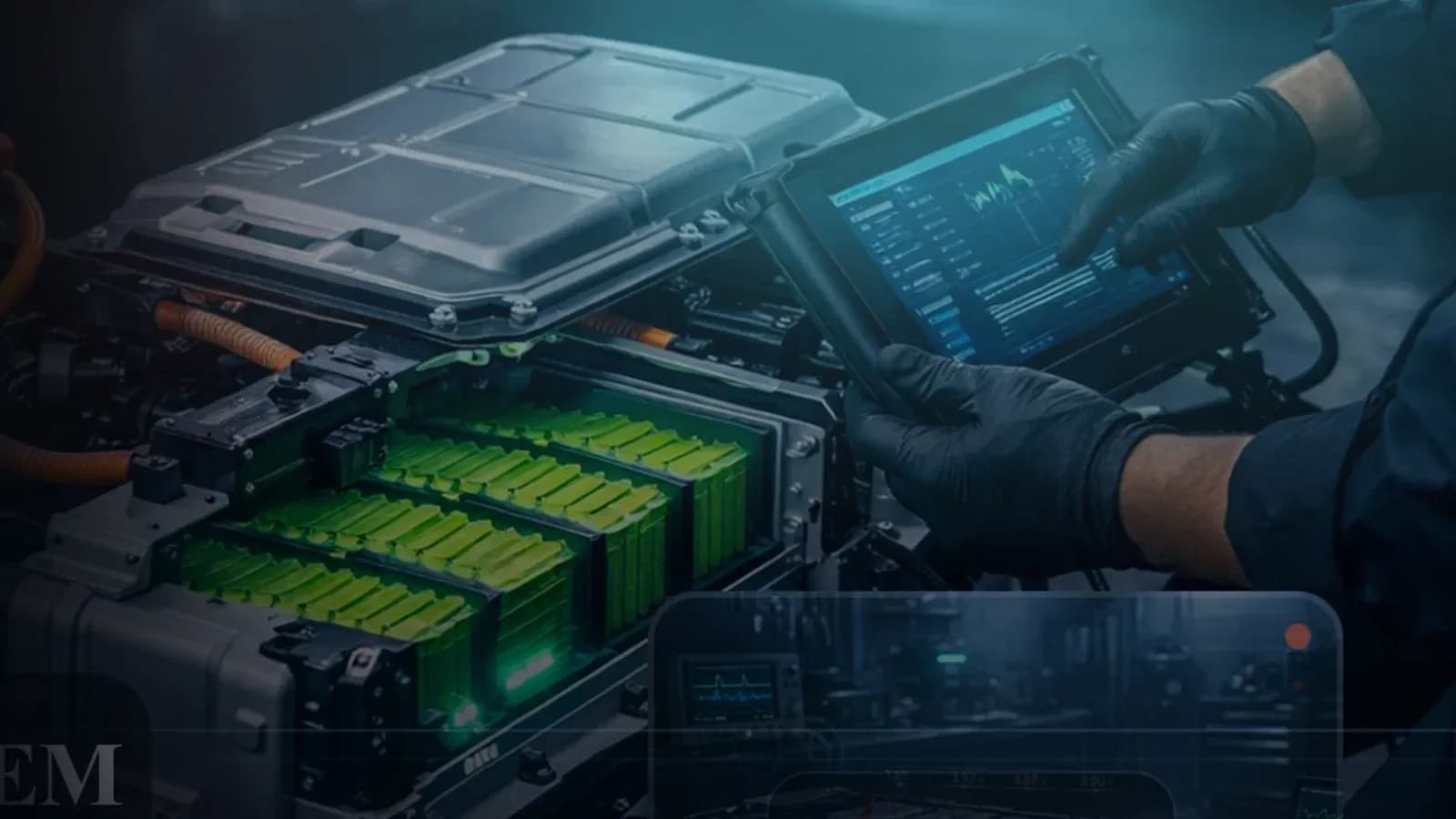
Toyota Prius in a workshop with a technician analyzing check hybrid system logs on a laptop.

In short: in Toyota, check hybrid system must be separated into 12V, HV and drive protective logic

Toyota can report check hybrid system under very different scenarios, from weak 12V supply to a real HV battery problem or pack cooling. Without a sequence of events, such a message is too broad to fairly estimate a repair.

That's why the most sense is made by a parallel view of 12V state, HV blocks, temperatures, battery fan and system response during startup and load.

A broader context of the HSD architecture itself can also be found here: guide to the Toyota Hybrid Synergy Drive system.

Zapamiętaj

Komunikat vs dane

Komunikat to dopiero początek. Dane dopiero zaczynają rozmowę.

Toyota is associated with a predictable hybrid, but the check hybrid system message still doesn't tell you which layer of the system actually failed. To distinguish between a 12V problem, HV pack, battery cooling or inverter protection strategy, you need to dive into live data and see the sequence of events.

Toyota check hybrid system: what does this message really mean?

The phrase 'Toyota check hybrid system' comes back very often because from the driver's perspective the message looks like a diagnosis. In practice, it's only information that one of the hybrid drive operating conditions is no longer consistent with the controller's expectations.

To narrow down the cause, you need to check specific parameters: 12V battery voltage (norm >12.4 V after 2h rest; <11.8 V = problem), HV pack voltage (Prius III NiMH: nominal 201.6 V = 168 cells × 1.2 V; Prius IV Li-ion: 207.2 V), Delta V between modules (norm <0.3 V, concerning >0.6 V, critical >1.2 V — then P0A80 Replace Energy Storage Assembly), HV battery temperature (norm <45°C, alarm >55°C) and pack cooling fan current.

Toyota Prius check hybrid system stop the vehicle in a safe place: which data to check first?

In the Prius, this message usually means the controller deemed further driving risky for a system component. Key parameters to check first: Auxiliary Battery Voltage (if <11.5 V during startup — 12V is a likely source), HV Battery Block Voltages (14 blocks of 12 cells in Prius III — spread >0.6 V between weakest and strongest = degradation), Battery Intake Air Temperature (>50°C = blocked fan filter under the rear seat).

The most revealing here is the startup log (Ready ON transition), EV→ICE transition log (when MG1 starts the combustion engine) and load recording at the moment the car stops responding normally to the throttle. In Prius III after 200,000 km, typical SOH drops to 60–70% — but SOH drop alone is not yet a message, as long as Delta V hasn't exceeded the BMS threshold.

Did you know...High Voltage

Układ HV w EV/HEV używa "masy pływającej" — obwód wysokiego napięcia jest całkowicie odizolowany od karoserii. Gdy izolacja spadnie poniżej 100 Ω/V, BMS natychmiast odcina zasilanie.

Read more
Did you know...High Voltage

Standard ECE R100 wymaga minimum 100 Ω na każdy volt napięcia DC i 500 Ω/V dla AC. Dla systemu 400V to minimum 40 kΩ rezystancji izolacji.

Read more

Toyota Auris check hybrid system: what in the battery and cooling data tells the most?

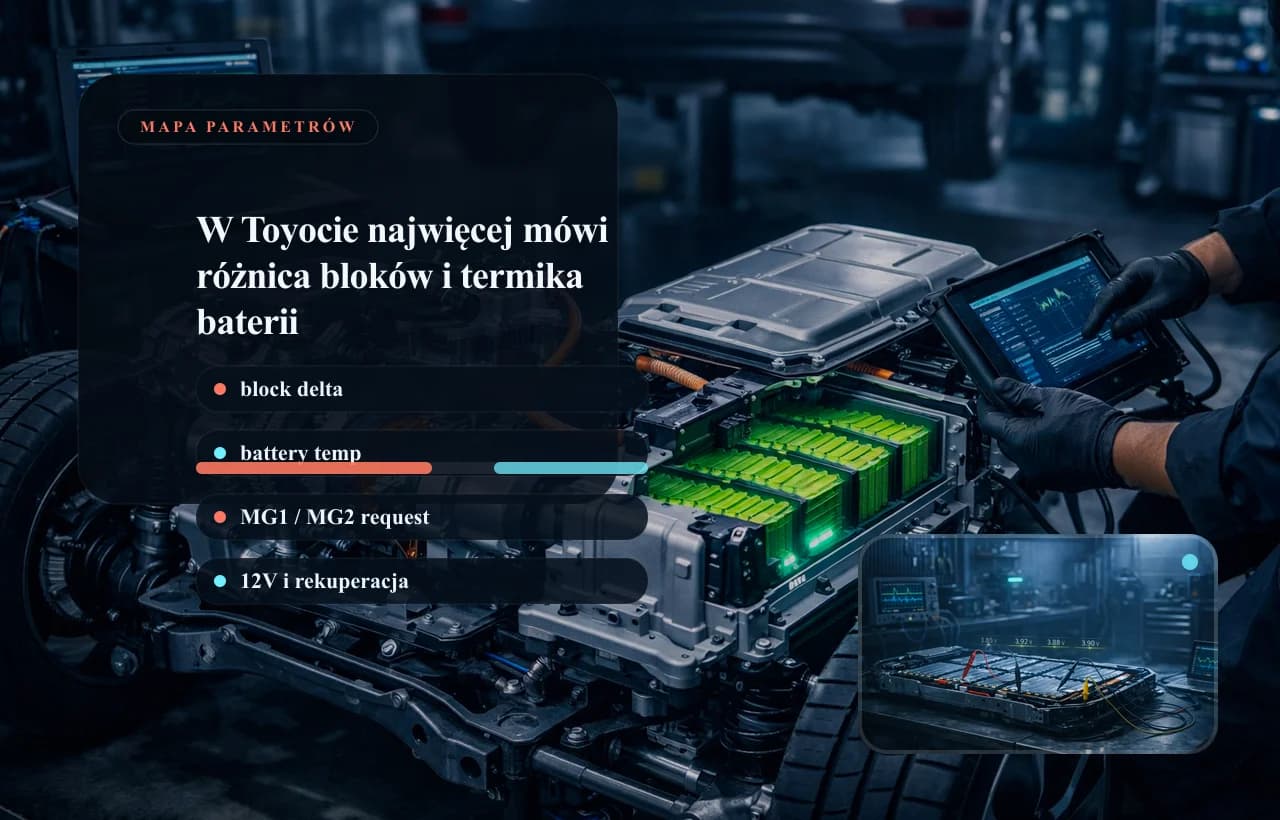
Toyota live data panel: MG1/MG2, SOC, voltage delta and hybrid battery temperatures.
Toyota Live Data

Check hybrid system is a collective message

First you need to see 12V, HV, temperatures and inverter response, and only then estimate the battery or inverter.

Auto-suggestions around the Auris show well that users often look for a simple reset. Meanwhile, in the data you need to see: temperature trend (Battery Module Temp 1-3: norm 25–45°C, difference between modules <5°C), fan behavior (Fan Speed: 0 rpm at >45°C = blocked ventilation duct), block voltages (HV Block Voltage 1-14: deviation >0.3 V from average = module degrading faster).

In the Auris Hybrid (NHW20), a typical degradation scenario is a gradual increase in Delta V over 6–12 months, until the weakest module drops below the BMS threshold. Reconditioning individual modules costs 1,500–3,000 PLN, replacing the entire NiMH pack 5,000–8,000 PLN. Only data allows assessing which path makes sense.

Typowa pułapka

Koszt błędnej interpretacji

Najdroższa interpretacja zwykle pojawia się za wcześnie.

Auto-suggestions around the Auris show well that users often look for a simple reset. Meanwhile, in the data you need to see: temperature trend (Battery Module Temp 1-3: norm 25–45°C, difference between modules 45°C = blocked ventilation duct), block voltages (HV Block Voltage 1-14: deviation >0.3 V from average = module degrading faster).

Toyota Camry check hybrid system stop the vehicle in a safe place immediately: how to distinguish HV from a control problem?

In the Camry, the message can be more alarming, but still doesn't immediately point to one part. Without live data, you don't know if the car entered protection due to the battery, inverter, cooling or inconsistency in communication between controllers.

The most important here is comparing data before and after the warning occurred, because only that shows which parameter deviated first.

Toyota Prius check hybrid system no acceleration: when the problem doesn't start with the battery itself?

Loss of acceleration after a check hybrid system message doesn't automatically mean battery death. Sometimes the controller limits torque due to 12V, cooling or inverter protection, and the driver only sees the final effect in the car's dynamics.

That's why it's not worth equating one message with one expensive repair without a prior log and comparison of the entire system's behavior.

Decision: when monitoring is enough, and when Toyota requires full HV diagnostics

If the message appeared once and you have full data, sometimes you can start with trend monitoring. However, if the car regularly returns to check hybrid system, loses acceleration or switches illogically between EV and ICE, full diagnostics are needed.

In such a scenario, a pre-purchase audit for a hybrid or EV with a PDF report or directly HV diagnostics makes sense.

FAQ: Live data Toyota and check hybrid system

Does check hybrid system in Toyota always mean a worn traction battery?+

No. The message can result from the HV battery, but also from the 12V system, cooling, isolation, inverter control or safety conditions logged by the ECU.

Why can a Prius show check hybrid system and simultaneously lose acceleration?+

Because the controller can limit torque protectively before the driver sees the full set of faults. Only the startup log, load log and drive transition log show which layer was first.

Does resetting check hybrid system in an Auris make sense without data?+

No. A reset removes the context and temporarily suppresses the symptom, but doesn't answer whether the problem concerns the pack, auxiliary power or battery cooling.

Which parameters are most important in a hybrid Toyota?+

12V state, HV block voltages and temperatures, battery fan response, inverter behavior under load and the difference between requested and available torque.

Is it worth checking this topic before buying a used Toyota?+

Yes. If the car has a history of check hybrid system or behaves illogically during EV-ICE transitions, a pre-purchase audit allows separating a minor issue from real HV cost risk.

Related services

If you want to verify this, check the service

Consult result