
Hybspec
2026-03-0910 minBłędy, Objawy i AwarieSeries: Mercedes / AdBlue

Countdown to Start Lockout: Why the AdBlue Error in a Mercedes Isn't Always the Pump

You're returning from a trip in a Mercedes GLC, E-Class, or a fleet Sprinter, and suddenly the instrument cluster displays the message "Engine start not possible in 800 km." Mercedes likes to add premium drama at such moments, but the message itself still doesn't tell you which part has actually failed. However, it is very effective at triggering an avalanche of costly diagnoses and even more expensive ideas.
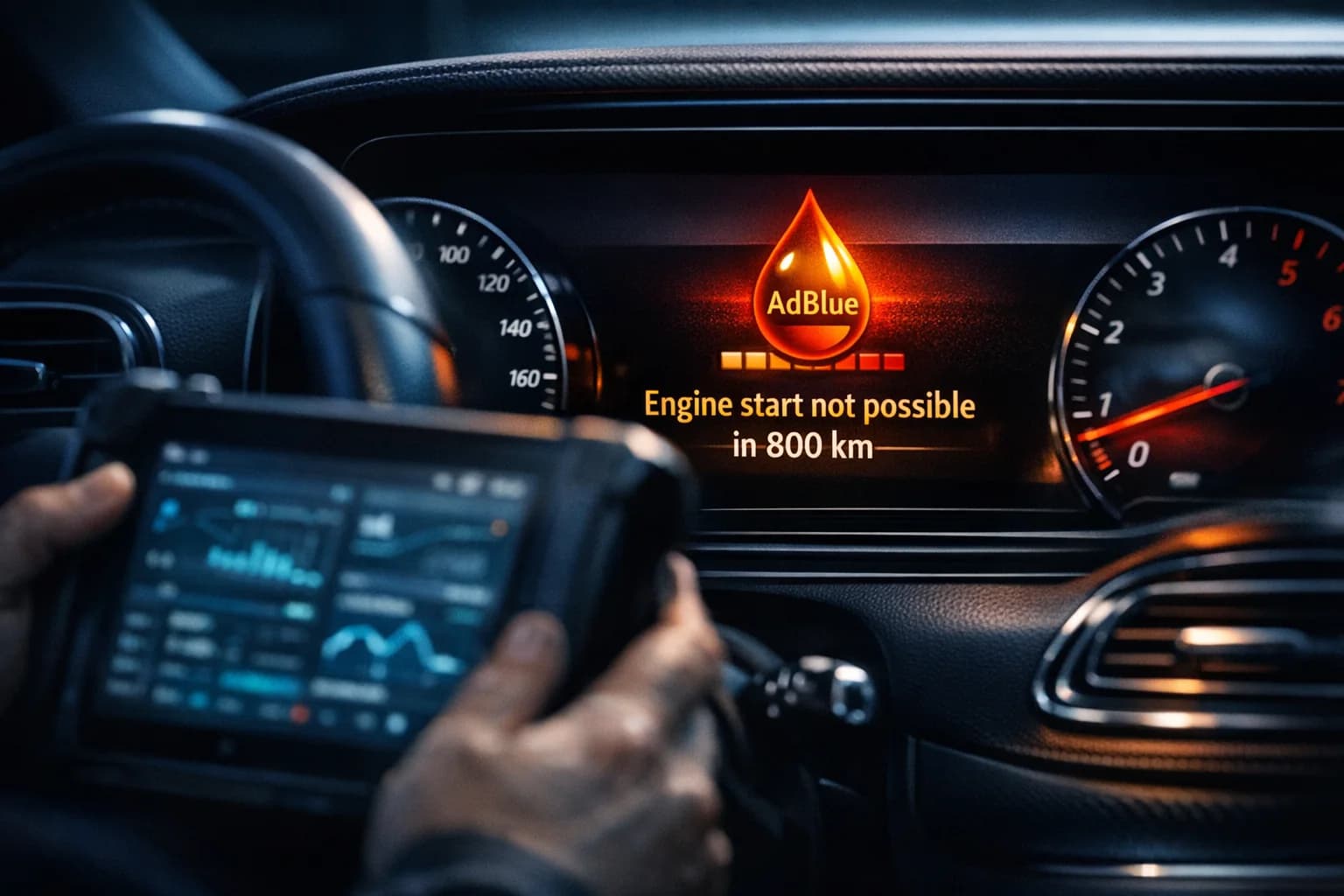
Deska rozdzielcza Mercedes-Benz z komunikatem o zablokowaniu rozruchu silnika z powodu usterki systemu AdBlue obok tabletu diagnostycznego.

In Short: The Start Lockout Message Indicates a Problem in SCR Logic, Not Automatically a Damaged Pump

When a Mercedes displays the message that the engine cannot be started in 800 km, the CDI/CRD controller is informing you of the ineffectiveness or inconsistency of the SCR system's operation. This is an important distinction, because the computer reports the effect, not the cause.

In practice, this same alert can be triggered by a clogged urea injector, a malfunctioning heater, a chafed wiring harness at the NOx sensor, old software, or a lack of proper adaptation after a previous component replacement. This is exactly the type of situation where a hasty "it's definitely the pump" costs the most.

Before you agree to replace a sensor for several thousand zloty, it's worth performing mobile Mercedes diagnostics with active SCR tests, because in many cars the problem lies next to the pump, not in the pump itself.

Zapamiętaj

Objaw vs przyczyna

Pierwszy winny z listy błędów rzadko bywa tym właściwym.

You're returning from a trip in a Mercedes GLC, E-Class, or a fleet Sprinter, and suddenly the instrument cluster displays the message "Engine start not possible in 800 km." Mercedes likes to add premium drama at such moments, but the message itself still doesn't tell you which part has actually failed. However, it is very effective at triggering an avalanche of costly diagnoses and even more expensive ideas.

Why Does the Controller Start the Countdown to Start Lockout?

The selective catalytic reduction (SCR) system injects a urea solution into the exhaust to reduce nitrogen oxide emissions. Mercedes compares several signals simultaneously: temperatures, pressure, fluid dose, the response of both NOx sensors, and the driving conditions under which the emissions test makes sense.

If any of these conditions does not match the expected map for an extended period, the controller determines that the system cannot guarantee emissions compliance and starts the countdown. Once it reaches zero, the lockout is software-based, so simply topping up AdBlue or clearing the codes works about as well as covering the warning light with tape.

This is precisely why reading the fault code alone is not enough. You need to check whether the controller sees a lack of dosing, incorrect pressure, a dead heater, a bad NOx signal, or catalyst inefficiency on the chemical side.

  • The entire SCR logic matters, not a single component
  • The controller evaluates emissions effectiveness under specific driving conditions
  • After reaching 0 km, repairing the cause and performing a service procedure is necessary

The Parts-Replacer Trap: The NOx Sensor and Pump Are Often Victims, Not the Cause

A typical scenario goes like this: a generic scanner shows a "NOx signal implausible" error, so the workshop orders a new sensor. The customer pays, drives away happy, and after a few dozen or a few hundred kilometers, the message returns. Then comes the verdict: "it's probably the pump."

The problem is that the NOx sensor is often just honestly reporting that the exhaust chemistry after the catalyst is still bad. If the injector is crystallized, the system doesn't hold pressure, or the tank heater doesn't allow fluid delivery at low temperatures, the new sensor will still show a bad result.

We see a similar error in thinking with general computer diagnostics for combustion engine cars, when someone interprets a fault code alone without live data, active tests, and checking the conditions under which the fault occurred.

Did you know...Operation

Wymiana akumulatora 12V w hybrydzie wymaga podtrzymania napięcia — bez niego sterowniki tracą adaptacje, a BMS może zablokować uruchomienie systemu HV.

Read more
Did you know...Diagnostics

Testy aktywne (np. włączenie wentylatora z testera) pokazują tylko, że komponent odpowiada na sygnał — nie mówią nic o tym, czy działa prawidłowo pod obciążeniem.

Read more

What Really Triggers the AdBlue Error in a Mercedes?

Mercedes' architecture is merciless here for those who diagnose "by ear." In models like the W205, W213, GLC, Sprinter W906, or newer vans W907, one symptom can have several technically different sources.

In practice, we are usually not looking for one "magic" part, but verifying the entire chain: whether the fluid can leave the tank, whether the nozzle is actually dosing, whether the controller sees the correct pressure, and whether both NOx sensors react according to the physics of the system.

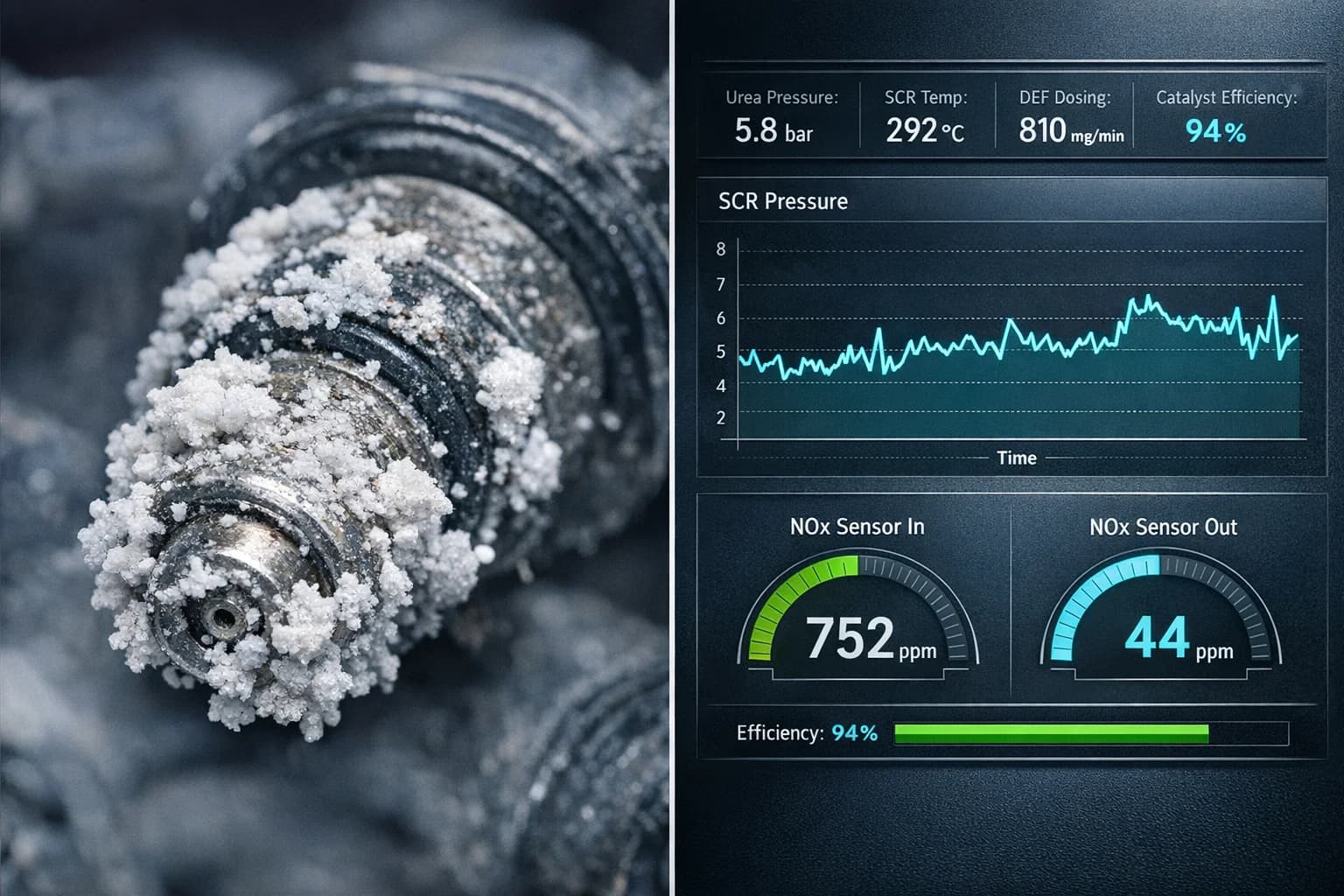
  • Crystallized AdBlue injector: a white crust blocks the dose, so emissions after the catalyst still look bad despite a working sensor.
  • Tank heater fault: in winter, the fluid doesn't reach operating conditions, and the controller considers the system ineffective.
  • Wiring harness or CAN communication issues: a chafed wire or corroded connector disrupts NOx readings and pump control.
  • Lack of software updates or adaptations: after a part replacement, Mercedes often requires a learning procedure, otherwise the error returns despite the new component.
Comparison of a crystallized AdBlue injector with a pressure graph and NOx sensor readings on a Mercedes diagnostic interface.
SCR Live Data

NOx Signal Is Not a Death Sentence for the Pump

Only by comparing the physical AdBlue dosing with live data can you determine whether the fault lies with the sensor, the pump, the injector, or the controller logic.

Typowa pułapka

Typowa pułapka

Jeśli diagnoza jest szybsza niż pomiar, zwykle jest też za droga.

Mercedes' architecture is merciless here for those who diagnose "by ear." In models like the W205, W213, GLC, Sprinter W906, or newer vans W907, one symptom can have several technically different sources. In practice, we are usually not looking for one "magic" part, but verifying the entire chain: whether the fluid can leave the tank, whether the nozzle is actually dosing, whether the controller sees the correct pressure, and whether both NOx sensors react according to the physics of the system.

How We Diagnose the AdBlue System Without Replacing Parts Blindly?

Before we unscrew anything, we access the controller at a level that allows active tests and engineering data. This is important in a Mercedes because only then can you distinguish between an error of "the sensor reports a bad result" and an error of "the system is actually not dosing."

We check the AdBlue pump pressure, run an injector dosing test into a measuring cup, observe live data from both NOx sensors on a hot exhaust system, and compare the response to engine load. If necessary, we also verify power supplies, grounds, voltage drops, and the condition of wiring harnesses.

Only after removing the true cause do we perform a start lockout reset, component adaptation, and learned procedures. Without this, even a correctly replaced sensor or SCR module can still throw the old error.

You Have 800 km, 200 km, or 0 km? Do This Before the Controller Permanently Locks the Start

Don't rack up costs through trial and error. If the message returns after topping up fluid or replacing a sensor, don't add more parts without confirmation from the data. The earlier you get a diagnosis, the greater the chance it will end with removing the specific cause rather than replacing half the system.

If the counter is already counting down, schedule Mercedes diagnostics and send a photo of the message, the car model, engine, and information about whether fluid was recently topped up or sensors were replaced via contact. This is usually enough to immediately plan the right test path.

The worst decision is to wait until zero and hope the problem will disappear on its own. In a Mercedes SCR system, the counter is often just the final stage of a longer process that had already given signals in live data, temperatures, and NOx reaction efficiency.

FAQ: AdBlue / SCR System Faults in Mercedes-Benz

My AdBlue counter dropped to 0 km and the engine won't crank. Do I have to tow the car to the dealership?+

Not always. If the cause is a software fault, an electrical issue, or an SCR component problem, it's often possible to diagnose the car on-site first and then decide on transport. The key is to determine whether the start lockout is due to a real hardware failure or unmet controller conditions after a previous repair.

Can I just delete AdBlue from the computer?+

We do not recommend this solution. Removing the SCR system is illegal, means losing type approval, and can result in a high fine during an inspection, especially abroad. In practice, it's better to remove the true cause of the error and restore proper system operation.

The error disappeared after topping up AdBlue, but the check engine light is still on. What does that mean?+

This is a common scenario. Simply refilling the fluid can clear the countdown counter, but the MIL (Malfunction Indicator Light) only goes out after successful self-diagnosis cycles. If the light returns after driving a few dozen kilometers, the SCR system usually still has a hardware fault or requires an adaptation procedure.

Does the quality of AdBlue fluid matter?+

Yes, and significantly. Incorrect urea concentration, contaminants, or fluid stored for a long time at high temperatures can trigger SCR efficiency errors. In Mercedes vehicles, the quality sensors and controller logic detect such problems quite quickly.

Related services

If you want to verify this, check the service

Consult result